 Retro Replay Retro Gaming History, Reviews & Emulation



Retro Replay Review
Gameplay
The first hour of Ishin no Arashi has an appealingly direct rhythm: choose a Bakumatsu-era general, tune the stats that define him, assemble soldiers, and start moving across turn-based grids. Instead of drowning you in the broad administration associated with many historical strategy games, it puts your attention on one leader’s route through a divided Japan. That narrower focus gives the game a sense of momentum. You are not merely staring at a map of factions; you are deciding where your general goes next and what kind of person he will become.
Training at schools, visiting shops, and running into friendly or hostile groups give the map movement a useful purpose. Knowledge, charisma, stamina, and attack power are not decorative choices when battles, negotiations, and diplomatic procedures lean on character statistics. Building a capable general becomes the real strategy. If you enjoy planning around preparation and risk—asking whether another stop at a school is worth the turn—you will find a satisfying, compact campaign structure here.
The catch is that confrontations resolve automatically. You can influence the odds through your general’s parameters and soldier choices, but you do not get to personally turn a battle around with tactical commands once it begins. That creates suspense when you have made smart preparations, yet it can also feel harsh when a major outcome lands against you. This is a better fit if you can accept strategy as setting conditions and living with the result, rather than demanding control over every clash.
Compared with larger Koei-style historical simulations, the reduced diplomacy is both a limitation and a strength. There are fewer political levers to pull, but the game moves away from bureaucratic sprawl and toward travel, encounters, and leader development. It is not the choice for someone wanting deep statecraft. It is a worthwhile oddity for anyone who likes historical strategy stripped down to a more character-centered expedition.

Graphics
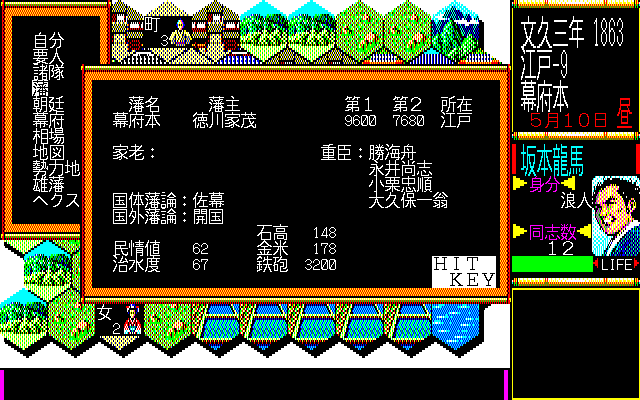
The game uses a top-down view for its turn-based town and countryside grids, keeping your general’s route and nearby locations easy to parse. Its anime/manga classification also suits the emphasis on notable characters rather than an impersonal military map.
Story
The setting does a lot of the heavy lifting, and fortunately it is a strong one. Ishin no Arashi takes place in the Bakumatsu period, when supporters of the shogunate and adherents of the Emperor fought over Japan’s future. That conflict carries built-in stakes: the country is poised between the final years of the Edo period and the Meiji Restoration that will reshape it.
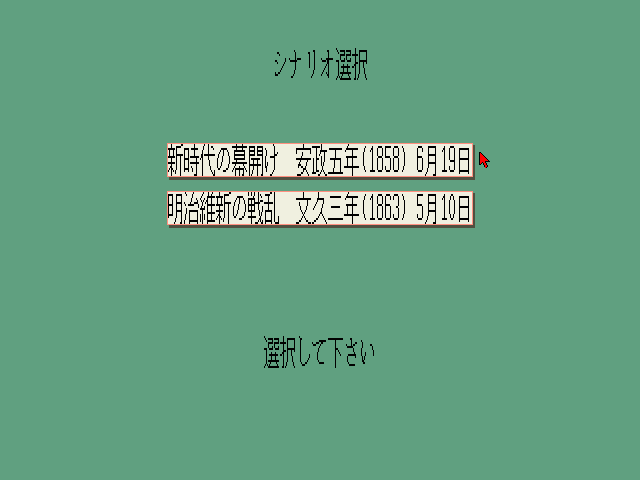
You choose from three major battles of the era and try to determine which leader drives Japan toward the Meiji age. That framing makes the story less about a single fixed hero’s journey and more about placing your chosen general inside a turbulent historical contest. The personal stat customization helps, because your leader feels like an active participant in that transition rather than a token moved through a textbook timeline.
Do not come in expecting elaborate diplomacy scenes to carry the drama. The narrative weight comes from the period, the opposing political forces, and the consequences attached to encounters and negotiations. For gamers already interested in late-Edo Japan, that is enough to give each route a sense of purpose. Everyone else may need a little patience before the historical context turns into emotional investment.
Overall Experience
Ishin no Arashi is engaging when you meet it on its own terms. It takes a volatile chapter of Japanese history and turns it into a turn-based journey built around a customized general, deliberate travel, and stat-driven decisions. The pull is not intricate battlefield control; it is the steady feeling that each school visit, encounter, and destination may improve—or endanger—your position in a larger national struggle.
Its most divisive decision is also its defining one: automatic battles and negotiations. If you hate surrendering the decisive moment to underlying numbers, frustration will set in quickly. If you enjoy setting up a plan, investing in a character, and seeing whether your judgment holds under pressure, the same system creates real tension. Wins feel earned through prior choices, while losses can sting precisely because you had to trust your preparation.
This is an easy recommendation for fans of Japanese history and older, focused strategy designs, especially if sprawling diplomacy has kept you at arm’s length from similar games. Give it a chance for its unusual balance of historical simulation and leader-focused travel. Skip it if direct control in combat and exhaustive political management are non-negotiable; Ishin no Arashi is more interested in the road to power than in letting you micromanage every step of the fight.



Reviews
There are no reviews yet.