 Retro Replay Retro Gaming History, Reviews & Emulation
Retro Replay Review
Gameplay
Taiyō no Yūsha: Fighbird gives its vertical shooting a more defined routine than a game that keeps one craft on screen from beginning to end. Its four stages move through three distinct roles: a Baron Team vehicle section, a Fire Jet assignment, and a final battle with Fighbird. The formula is straightforward, but it helps each stage feel like a small episode rather than a single uninterrupted stretch of scrolling fire.
The Baron Team phase is the game’s most flexible idea. You choose a member of the rescue team at the beginning, then can swap among the vehicles during play. That makes this part feel tied to a larger squad instead of serving as a disposable introduction before Fighbird arrives. Road Baron, a trailer truck, is a clear example of how these machines give the opening action a different flavor from the robotic heroics later in the stage.
Fire Jet changes the immediate focus by assigning specific jobs, including destroying or collecting certain objects. These assignments make the middle section more than a matter of shooting everything that scrolls into view, and they give the vehicle a useful role of its own. The interruption may test the patience of anyone who wants constant enemy pressure, but it is a welcome change from repeating the same target priorities for the entire game.
The campaign is short, and its recurring format leaves limited room to build dramatically on these ideas. Still, the selectable Baron Team machines and Fire Jet’s object-focused tasks give the action a more deliberate pace than its four-stage length might suggest. The main reward is seeing how each machine gets a turn in the spotlight before Fighbird closes out the stage.
Graphics
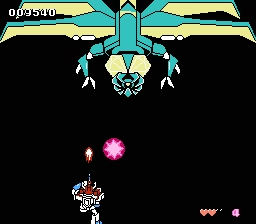
The active battle view makes its scale clear. A tiny red-and-white robot sits near the bottom of a mostly black screen, firing pink-and-white shots upward at a pale-green mechanical bird that dominates the upper area with long angular wings and a pointed body. The stark background gives the machines strong contrast, and the oversized enemy creates a satisfying David-versus-Goliath image even within the NES’s limited detail.
Story
The solar system is under attack from aliens led by Dryas, aided by the human scientist Dr. Jango. Their forces deploy mechabeasts against humanity on Earth and in space, while the Space Police Force must seek out the Evil Energy that constitutes Dryas and destroy the mechabeasts he sends out. It is a direct, high-stakes setup that gives the shooting a clear enemy and a clear purpose.
At the start, the game lets you choose Kenta or Yuutarou Katori. Kenta is a special Space Police Force member and the grandson of Dr. Hiroshi Amano, the scientist who develops the SPF’s mechs. Katori is the human identity of the space guardian Fighbird, keeping the title character closely tied to the mission regardless of the initial choice.
The plot establishes the conflict without getting in the way of the action. Dryas, Dr. Jango, the SPF, and the mechabeasts make the sides of the fight easy to understand. It is a simple framework, but it suits a compact shooter that quickly moves from rescue-team machinery to Fire Jet assignments and Fighbird-led confrontations.
Overall Experience
Fighbird’s strongest point is the way its anime license shapes the action. Swapping Baron Team vehicles means the early part of a stage is not locked to one machine, while Fire Jet’s specific assignments provide a different kind of target priority before the final battle. Those changes add personality to a game that otherwise has a very compact arcade-style structure.
That compactness is also the limitation. Four stages make for a short run, and the game returns to the same basic order each time. The vehicle changes and object-based Fire Jet tasks stop the format from becoming completely flat, but anyone hoping for a longer shooter that steadily adds new systems may find it ends just as its routine becomes familiar.
A useful comparison is Terra Cresta, another vertical shooter where changing the player’s fighting setup is a major part of the action. Fighbird uses its different machines and forms to keep the focus on the characters and vehicles from its anime setting. For fans of the series, that makes it a worthwhile curiosity; for shooter fans, it is a brief, structured game whose best moments come from making each machine’s section count.


Reviews
There are no reviews yet.