 Retro Replay Retro Gaming History, Reviews & Emulation
Retro Replay Review
Gameplay
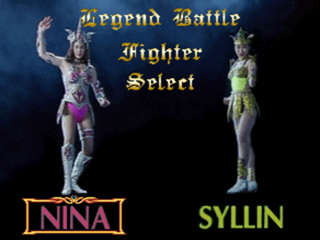
The first hour of Twin Goddesses is easy to understand and fairly easy to buy into. Legend Battle asks you to choose Nina or Syllin, then take their fight from Carmilla’s minions all the way to the witch herself. It is a clean, no-nonsense fighting-game framework, but the kingdom-saving objective gives the sequence more momentum than a string of unrelated matches.
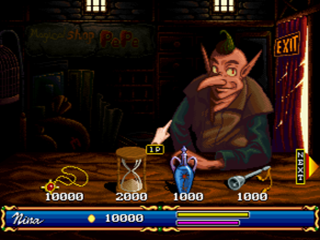
The most interesting wrinkle comes between battles. You can spend money on items to help in the next fight, so there is at least a small decision to make after each win: take what sounds useful now or consider what may help later in the run. That does not turn Twin Goddesses into a complex campaign fighter, but it breaks up the usual fight-rematch rhythm and gives Legend Battle its own shape.
Outside that mode, the package is lean. Two-player Versus Mode is there for a direct match against another person, while Legend Battle is where the game puts its narrative stakes and progression. If you want a focused, old-school fighter with a campaign attached, that simplicity can be refreshing. If you want a huge roster, stacks of modes, or a long list of systems to master, the narrow scope will start to show quickly.
Graphics
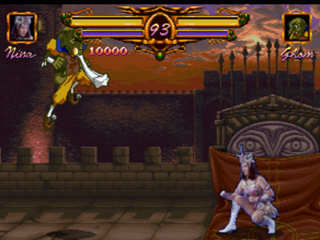
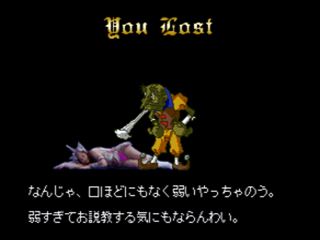
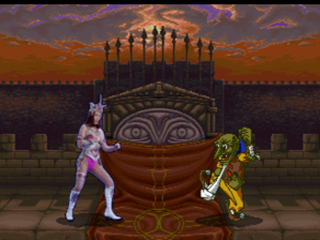
The characters are the visual talking point: Twin Goddesses mixes hand-drawn 2D sprites with digitized photographs. It is an unusual combination for a fantasy fighting game, and it gives Nina, Syllin, Carmilla, and the opposing cast a distinctly odd early-PlayStation-era look rather than a fully unified anime style.
Story
The story does not waste time getting you into the conflict. Carmilla and her five servants strike down King Loveradiant III and cover the Kingdom of Loveradiant in darkness, leaving his twin daughters to answer the threat. That is broad fantasy melodrama, but it is exactly the kind of setup that works for a single-player fighting-game ladder.
Nina and Syllin are not simply handed the throne; Zeus grants them the powers of love and courage, then sends them toward the forces that broke their family and kingdom. The mythology and royal-family stakes give the sisters a clear reason to fight, even if the tale is built to move you from opponent to opponent rather than linger on intricate plotting.
Choosing either sister lets you place a different heroine at the center of the same rescue mission. Carmilla is a suitably obvious final target, and working through her servants before confronting her gives the campaign a clear climb. Go in for a colorful good-versus-evil premise, not for a tangled fantasy epic.
Overall Experience
Twin Goddesses has the charm of a very specific kind of 1994 fighter: compact, sincere, and a little strange. The story mode, item purchases, and versus option give it enough structure to feel like more than a bare series of fights, while the mixed sprite-and-photo character art makes it difficult to confuse with a more conventional anime brawler.
The tradeoff is that it does not have much room to spread out. Once you have seen Legend Battle through a chosen twin and sampled Versus Mode, the central question is whether you enjoy returning to its core fights. That makes it better suited to a short retro session or a curious local match than to someone hunting for months of discovery.
Give it a chance if obscure PlayStation fighters, fantasy heroines, and unusual character art sound more inviting than a polished modern package. Twin Goddesses is not a deep all-purpose recommendation, but its focused campaign and peculiar visual mix make it a worthwhile historical oddity for the right gamer.


Reviews
There are no reviews yet.