 Retro Replay Retro Gaming History, Reviews & Emulation

Retro Replay Review
Gameplay
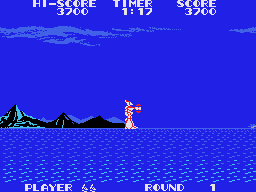
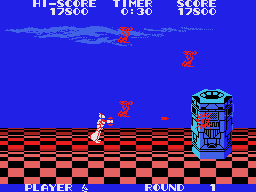
Your first few runs are likely to end with the timer feeling like the real final boss. You are racing horizontally toward a space-time weapon, dodging hostile craft and ground turrets while deciding when it is safe to slow down. Orguss makes that decision central from the start: its ship form moves the stage along faster, but each shot requires its own button press.
Transforming into Orgroid changes the rhythm immediately. Holding fire produces repeated shots, which is a big advantage when enemies crowd the route, but the screen scrolls more slowly in mech form. Lean on it too hard and you can survive the firefight only to lose the mission because you simply did not arrive in time. That is a genuinely clever bit of arcade pressure, and it asks you to think about travel speed and firepower as competing resources rather than simple upgrades.
The downside is how little room Orguss gives that idea to grow. There are no power-ups to chase, no alternate tools to unlock, and only one stage. Once you understand where danger tends to come from, the experience becomes a hard route-practice exercise: learn when to remain a ship, transform only when the extra fire is worth the lost time, and make every second count.
That can be satisfying in short bursts. The repeated stage returns at increased difficulty after completion, so improvement has a clear target. But the game is too spare to sustain much curiosity beyond the pursuit of a cleaner run, and its rigid time limit can turn an otherwise promising attempt into a frustrating failure.
Graphics
Orguss uses a side-view, horizontally scrolling battlefield built around the transforming player craft. You fly past hostile craft in the air and stationary turrets on the ground, with the shift from ship to Orgroid giving the action its clearest visual hook.

Story
The setup is direct, urgent anime sci-fi: Terram has built a weapon capable of destroying space-time, and you have two and a half minutes to reach it and shut it down. It is an effective excuse for the timer, not a story that develops as you play.
Even so, the premise fits the arcade structure well. A looming catastrophe explains why there is no time to linger, while piloting the Orguss in two forms gives the licensed mecha angle a practical purpose in the action.
Do not come to Orguss for character drama or a deep adaptation of its anime source. The narrative is a mission briefing distilled into a score-chasing shooter, and the game keeps its attention on that countdown.
Overall Experience
Orguss has one good idea and commits to it: power is tempting, but power costs time. The faster ship and slower, rapid-firing mech create a tension that is easy to understand and tougher to manage than it first appears.
Its limitations are equally immediate. A single repeating stage and no power-up system make the game feel more like a concentrated arcade challenge than a full journey. If the basic route does not click with you, there is little else here to change your mind.
Give it a chance if you enjoy old shooters that demand repeat attempts, strict timing, and small tactical decisions made under pressure. Everyone else may admire the transformation trade-off, then find the repetition arrives long before the challenge has earned much patience.


Reviews
There are no reviews yet.