 Retro Replay Retro Replay gaming reviews, news, emulation, geek stuff and more!
Retro Replay Review
Gameplay
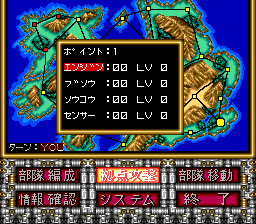
High Grenadier starts from a wonderfully direct board-game idea. Your commanders and their mech forces move across a battlefield made of dots linked by lines, one adjacent point at a time. That limitation quickly becomes the whole game’s pressure point: routes matter, positions matter, and a badly timed advance can put a unit into an encounter you did not really want.
When opposing forces land on the same dot, you choose attack, defend, or retreat, then combat resolves automatically according to the units’ statistics. That can be frustrating if you want to micromanage every exchange; you are making the commitment before the numbers do their work, not winning battles through last-second tactical commands. But it also gives each decision a welcome finality. You need to judge the matchup and the map before contact, because there is no action-game dexterity to rescue a poor call.
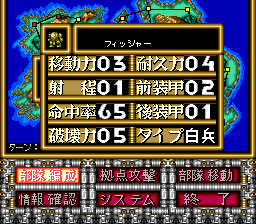
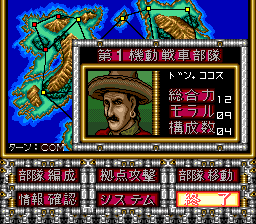
The strongest reason to stick around is the ability to level up individual mech parts by freely assigning earned experience to their parameters. It turns the commanders’ forces into long-term projects and makes victories feel useful beyond simply clearing the current opposition. You begin with three of the six commanders, while the others arrive later, giving the campaign a gradual sense of expansion. Come to it for deliberate positioning and stat-building, not a deep menu of combat options.
Graphics
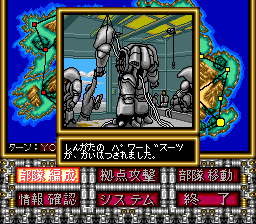
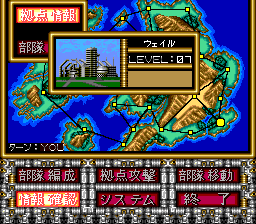
The top-down battlefields reduce movement to clear dots and connecting lines, making it easy to see where a commander can go and where an enemy can cut them off. Its anime-mecha framing keeps the focus on giant robots and their commanders rather than realistic military detail.
Story
There is a conflict between two human organizations, both fielding and commanding giant mechs, but High Grenadier keeps that setup highly abstract. The war functions more as a reason to stage the battles than as a narrative you are likely to become invested in.
That sparseness is not fatal for a strategy game built around movement and unit growth, yet it does mean the commanders carry little dramatic weight beyond their use on the field. Unlocking another commander feels like gaining another strategic asset, not meeting a richly drawn character.
If you need campaigns to supply personalities, revelations, or a strong reason for every fight, this will feel thin. If a clean sci-fi conflict is enough to frame a sequence of tactical problems, the minimal storytelling stays out of the way.
Overall Experience
High Grenadier is a compact strategy-RPG whose best moments come from committing to a route, weighing a confrontation, and then seeing whether the unit growth choices you made pay off. The automatic battles ask you to think ahead, which gives the simple map structure more bite than it initially appears to have.
Its narrowness is also its biggest obstacle. There is a real chance that the dot-and-line maps and attack/defend/retreat decisions will feel repetitive, especially if you expect tactical combat to unfold under your direct control. The game asks you to enjoy preparation, probability, and progression more than spectacle.
For the right gamer, that trade is worthwhile. Give High Grenadier a chance if you like old strategy games that turn a small ruleset into a steady stream of consequential choices, and if raising mech stats sounds more satisfying than being handed elaborate battle commands. Everyone else may find its abstractions too austere to push through.


Reviews
There are no reviews yet.