 Retro Replay Retro Gaming History, Reviews & Emulation


Retro Replay Review
Gameplay
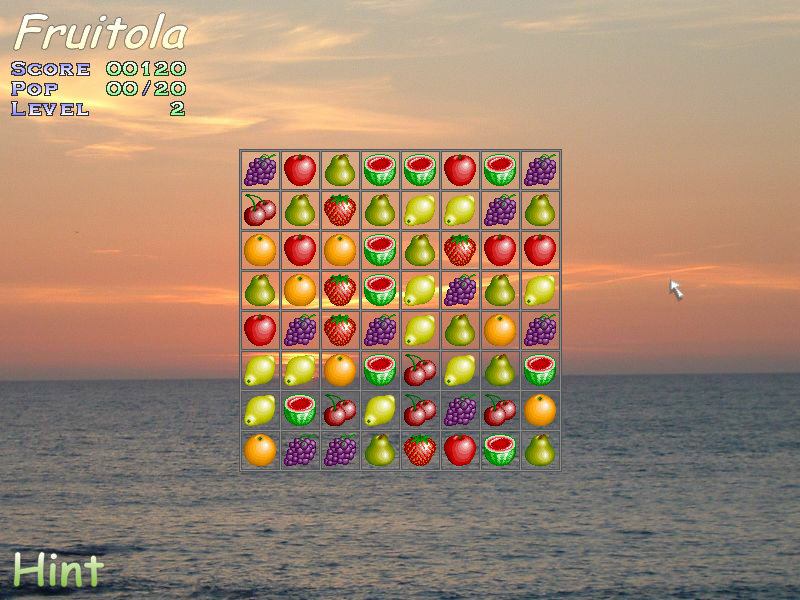
Fruitola starts with the kind of match-three loop you can understand in seconds. You use the mouse to swap two fruits, make a horizontal or vertical line of at least three, and let the matched pieces pop while more fruit drops into their spaces. Apples, watermelons, grapes, oranges, pears, lemons, strawberries, and cherries are all serving the same basic purpose, which keeps your attention on spotting the next move rather than learning a pile of exceptions.
That simplicity makes the first level easy to settle into. Clearing ten fruits is a small enough goal that you can quickly get a feel for scanning the board and choosing swaps. Then the target rises with each level—twenty fruit for level two, and so on—and the casual opening becomes a test of whether you can keep producing matches often enough to meet a growing quota.
The tension comes from the hard failure condition: if there are no available matches, the run ends. That gives every swap more weight than in a more relaxed tile matcher. It can be frustrating when a board dries up before you have reached the target, especially since the required number of popped fruits keeps increasing, but it also prevents the routine from becoming completely mindless. Fruitola works best in short bursts, when you want a direct little board puzzle and do not need much beyond the satisfaction of clearing a clean line.
Graphics
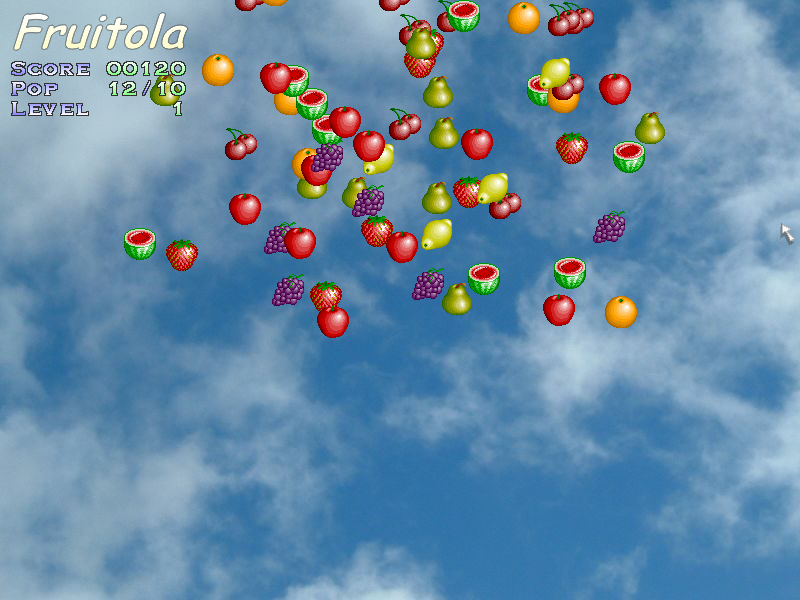
The board is built around a bright, familiar fruit assortment: apples, watermelons, grapes, oranges, pears, lemons, strawberries, and cherries. Because the pieces are easy to distinguish by shape and color, you can spend your time looking for swaps instead of deciphering what sits where.

Story
Fruitola does not ask you to follow a dramatic journey; its forward motion is the escalating level goal. You clear ten fruits, then twenty, and continue chasing larger totals. That stripped-down structure suits a game that wants you back on the board quickly.
The fruit theme is cheerful rather than meaningful, but it gives the puzzle a lighter feel than a grid of abstract symbols would. Popping a cluster of cherries or lemons is immediately legible, and the falling replacements create the small sense of momentum the game needs.
If you need characters, twists, or a reason to care about anything beyond your current target, this will feel thin. If a game can simply be a compact sequence of increasingly demanding boards, Fruitola is honest about that from the start.
Overall Experience
Fruitola is a clean, old-school match-three game built around one rule set and one escalating demand: clear more fruit before the board leaves you without a move. Its best quality is how little stands between you and the puzzle. You can start a round, make a few swaps, and immediately know whether your eye for patterns is holding up.
The downside is equally clear. There is not much cushioning around the central idea, so repetition arrives quickly if you want a match-three game with lots of changing rules or a broader sense of progression. The increasing fruit targets add pressure, yet they do not fundamentally change how you play.
Give it a chance if you enjoy straightforward mouse-driven tile matching and can appreciate a game that makes a dead board a genuine threat. Skip it if you want a sprawling puzzle campaign or a forgiving way to unwind. For a brief, focused session, Fruitola has enough bite to justify a few more swaps.


Reviews
There are no reviews yet.