 Retro Replay Retro Gaming History, Reviews & Emulation

Jerremy Koot, known in the early emulator scene as The Teacher, created Snes96 for Windows and later contributed to Snes97 and Snes9x. His work began while the Super Nintendo was still a current commercial platform and PC emulation of it was far from dependable. The project is important both as a 1996 experiment and as the starting point for work that continued across other operating systems.
Name: Jerremy Koot
Handle: The Teacher
Best known for: Snes96, Snes97, and Snes9x
1996 milestone: Snes96 Win32 0.3.2, catalogued on August 22, 1996
Why he matters: Helped establish a continuing portable SNES emulator lineage
Snes96 Begins on Windows
Patent Pending’s preserved release catalog lists Snes96 Win32 0.3.2 under Koot’s name with an August 22, 1996 date. Its ordinary Windows interface sat around an unusually difficult task: making a PC reproduce the coordinated behavior of Nintendo’s CPU, graphics hardware, memory transfers, and separate audio system.
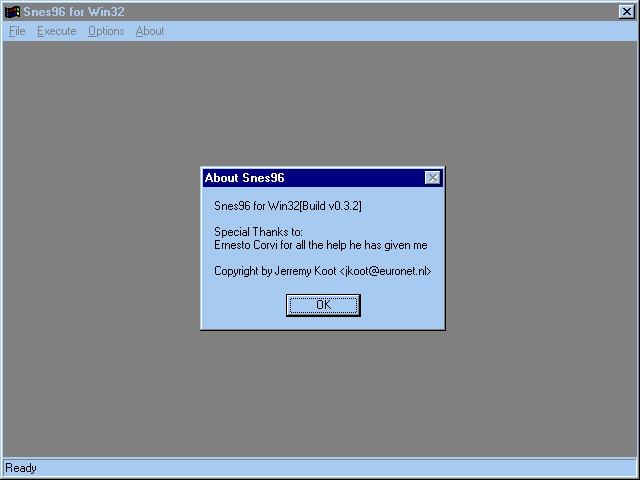
A familiar desktop did not make the emulated machine simpler. It did make the program easier to encounter as an application. That combination of experimental internals and approachable presentation belongs to the broader transition taking place in console emulation during the mid-1990s.
Gary Henderson Builds on the Original
A strong primary account survives in Gary Henderson’s May 22, 1997 release announcement. Henderson identifies his Linux version as a port and rewrite of Koot’s original Windows 95 emulator and credits Koot’s work on both Snes96 and Snes97. The announcement connects the projects directly, without relying only on a later retrospective.
It also gives a revealing picture of the remaining work. Henderson described a C++ implementation with an assembly CPU core for Linux and DOS, and explained that missing sound emulation still caused games to fail. Those are details of the 1997 ports, not a feature list that should be projected back onto the 1996 Windows release.
From a Year-Named Program to Snes9x
Koot’s later Snes97 work and his collaboration with Henderson contributed to Snes9x. The surviving Snes9x source credits and period project pages preserve both names. The significance of Snes96 is therefore more than a place in a list of first attempts: work begun under that name continued to be revised and combined with other contributions.
That continuity matters in emulator history. Many early projects survive only as a binary and a few screenshots. A project that other programmers could extend had a different kind of future, one in which fixes and discoveries could outlive an individual release or host platform.
The Teacher in the Surviving Record
Period emulator catalogs identify Koot with the handle The Teacher. The later History of Videogame Emulators profile supplies the portrait used here. Its date and original photographer are not stated, and the portrait’s identification follows that profile; it is not presented as a photograph taken during the development of Snes96.
This biography concentrates on the documented software work. Personal details from later profiles are not needed to explain Koot’s place in the timeline. His contribution can be followed through the archived Windows release, Henderson’s direct acknowledgment, and the project credits that carry the story forward.
Why Jerremy Koot Matters
Koot helped make SNES emulation something other programmers could keep building. In 1996 that meant a small Windows application trying to reproduce a complicated console. In the following years it meant a lineage with more contributors, more host systems, and a much longer life than the number in its original name suggested.
Jerremy Koot in the History of Video Game Emulation
1996 Part I: iNES, Snes96 and the Nintendo Emulation Race
Jerremy Koot enters the timeline in the chapter about Nintendo emulator development in 1996.