 Retro Replay Retro Gaming History, Reviews & Emulation

John Saeger created z26, an Atari 2600 emulator whose first release arrived on August 28, 1997. In a year dazzled by newer consoles, his work kept one of the earliest home game machines in the technical conversation.
Name: John Saeger
Known for: z26 Atari 2600 emulator
First release: Version 0.8 on August 28, 1997
Technical challenge: Reproducing display timing on a different machine
A small console with a strange display
An Atari 2600 game can look simple beside a PlayStation title. That does not make its hardware simple to emulate. The console’s Television Interface Adaptor did not give programmers a comfortable full-frame image in memory. Game code had to time changes as the television beam moved across the screen. Different games exploited that tight relationship in different ways. An emulator that merely interpreted the 6507 processor would miss the behavior that made the games visible and playable. Reproducing the 2600 meant paying attention to cycles, scanlines, input, and sound in a way that a static screenshot cannot explain.
Saeger’s z26 entered that problem space in 1997. The project’s own repository history dates version 0.8, its first release, to August 28. The name is compact, but the ambition was broad: make the Atari library run on a PC while preserving enough of the original timing to keep games recognizable. It joined an existing field of Atari 2600 experiments rather than inventing the category. What gave z26 significance was sustained work after the first build, with later versions improving accuracy and usability over many years.
What a player wanted
For a player, the appeal could be immediate. A familiar cartridge that no longer had a working console or television connection could appear on a computer. The color, paddle movement, joystick response, and sound needed to feel close enough to the remembered game. If the ball in a paddle game moved at the wrong pace, the game was technically running and emotionally wrong. These details are why the Atari 2600 is an excellent test case for the word faithful. Its graphics are sparse, so timing and control have nowhere to hide.
The original hardware’s variety also complicated compatibility. Some cartridges used extra circuitry or unusual tricks. A game that fit one common pattern might work while another displayed garbage or lost input. A project like z26 had to learn from those failures, not merely grow a checklist of titles. The release history is therefore part of the biography. It records a programmer who kept returning to the same machine as more exceptions became visible. The first public version is a beginning, not the finished measure of the work.
What a programmer wanted
An emulator for the 2600 is more than a nostalgia player. It can help people write new software for old hardware. A homebrew programmer needs to test how a scanline effect behaves, whether an input routine responds correctly, and what happens near the limits of the console’s timing. Real hardware remains the best final test, but a capable emulator shortens the loop between changing code and seeing a result. z26’s later use in the homebrew community shows why preserving machine behavior has value beyond replaying commercial cartridges.
That role connects Saeger’s work to the larger 1997 story. MAME developers were describing arcade boards; SNES teams were learning sound and graphics modes; PlayStation programmers were inspecting executables. They were all making hardware behavior legible through software. The Atari 2600 demanded a particularly direct confrontation with timing because its software and display were so tightly coupled. Work on it could teach lessons that a more modern machine’s convenient graphics hardware might hide.
A quieter kind of persistence
The z26 story had less public drama than the Snes9x and ZSNES argument. That should not make it an afterthought. The scene’s news pages naturally rewarded surprising current-console targets and spectacular screenshots. Accurate emulation of an older, visually sparse machine was less likely to produce a viral first impression. It required patience, repeated testing, and a willingness to care about a game that others dismissed as primitive. Saeger’s sustained project gave the Atari 2600 a strong place in PC emulation even as attention moved toward newer systems.
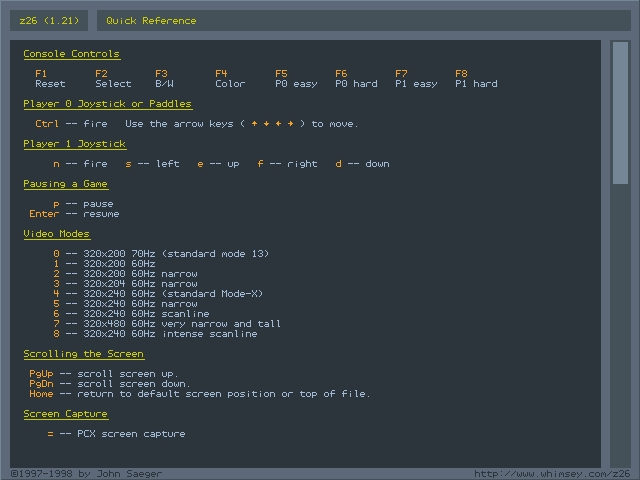
The biography uses a question-mark portrait placeholder and a later z26 screen, not a photograph of Saeger or a screenshot of version 0.8. It is labeled that way because no verified portrait was located in the material used here, and because later interfaces should not be mistaken for a first-release capture. The source-backed facts are the creator’s name, the project’s first release date, and the continuing work recorded in its repository. Those are enough to explain his importance without adding uncertain private details.
Why he belongs in 1997
Saeger is a useful corrective to the idea that emulation history only moves forward with the age of its targets. In 1997, programmers were attempting the Nintendo 64 and PlayStation while still finding new ways to represent the Atari 2600. Both directions were progress. One tested the edge of what a PC could imitate; the other deepened understanding of a foundational machine. z26’s first release placed Saeger among the people who made that second path durable.
The next time a 2600 game looks effortless on a modern screen, remember the effort hidden behind the simplicity. Every color change and responsive input passed through software that had to decide how the original machine behaved. Saeger started putting those decisions into z26 in 1997 and kept refining them. The accomplishment is quieter than a famous public feud, and it belongs in the same history.
John Saeger in the History of Video Game Emulation
1997 Part II: The 16-Bit Race, PlayStation Dreams, and a Public Fallout
John Saeger enters this history in the 1997 chapter. created z26 for the Atari 2600. Its August 1997 debut kept one of gaming’s oldest consoles in a year crowded with newer and flashier targets.
Related People
- Michael Tedder (Breakpoint) — led Project UnReality as Breakpoint. Its experimental 1997 Nintendo 64 release offered a glimpse of a new frontier, even though commercial play remained far away.
- Nicola Salmoria — brought separate arcade experiments together as MAME in February 1997. His reusable approach gave contributors a way to add new machines and games far beyond the original five.