 Retro Replay Retro Gaming History, Reviews & Emulation

Larry Bank worked in the specialist arcade field while larger projects drew the biggest headlines. His CAGE work is a reminder that 1998 progress came from many focused programs, not one expanding download.
Name: Larry Bank
Known for: CAGE and other specialist arcade-emulation experiments
1998 connection: CAGE appears in the contemporary arcade-emulator wave
Historical caution: The preserved screenshots do not establish every early build’s capabilities
A specialist among specialists
Larry Bank belongs to the group of programmers whose 1998 work is easy to lose behind MAME’s very long release list. CAGE appeared in the February arcade-emulation wave. Its significance is not that it overtook every rival; it is that it treated a defined set of arcade hardware as a solvable puzzle. Such projects could devote attention to one game’s timing, display, or input behavior while a general emulator spread its effort across many boards. For someone who cared about that cabinet, the narrow program could be the most important one on the page.
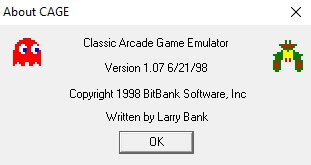
The old scene was full of technical experiments with names that no longer circulate widely. Some survived as independent projects, some stopped, and some fed code or knowledge into larger frameworks. Bank’s place in that landscape should be described without inventing a clean end-to-end chronology from a few surviving images. The preserved CAGE captures show the program’s identity, but an undated screenshot is not evidence that a particular feature existed in the February release.
Why one cabinet could take so much work
Arcade machines could share processors and still differ in crucial devices. A programmer trying to bring one game home had to understand memory layout, graphics decoding, sound chips, interrupts, and controls. If a game used a protection scheme, even correct visible graphics might not lead to playable action. An emulator that ran a handful of titles accurately could demand more reverse engineering than a long list of partial title screens. That is why the contemporary records need to be read as release reports, not as a simple scoreboard.
The MAME project history illustrates the same issue from a broad project’s perspective. In 1998 it recorded the first official nonworking game and new hardware support separately. The distinction makes specialist work easier to appreciate. CAGE and similar programs did not need to claim every arcade title; they needed to make a particular board behave well enough that its game could be understood and enjoyed.
What the record allows us to say
Bank’s work sits beside Richard Bush’s Raine, Nao’s M72 effort, NeoRage, Retrocade, and many smaller programs. Their audiences overlapped, but their goals did not always. Some sought a favorite title, others a family of boards, and others a better way to browse or launch games. Those distinctions made 1998 lively. They also mean it would be misleading to credit one person for every arcade breakthrough readers saw that year.
The surviving Archaic Ruins arcade directory shows how many focused programs a reader could encounter. Bank’s biography is therefore also a biography of a way of working: choose a machine, figure out how it behaves, show the result publicly, and let players test the claim. The public record for his early releases is thinner than for MAME, so this page keeps its dates and achievements modest rather than filling the gaps with legend.
Context and legacy
The local research history preserves a more personal explanation of Bank’s motivation: he wanted arcade favorites such as Galaga and Robotron available in the way he used his Windows NT computer. That account is a useful lead but still calls for independent confirmation before it becomes a precise first-person quotation. It does show why CAGE belonged to the Windows side of a scene where many celebrated emulators still began in DOS. A practical annoyance with one’s own machine could lead to months of low-level work on an old arcade board.
CAGE’s later relationship to HiVE gives the project a longer arc. A later HiVE catalog identifies HiVE as CAGE’s successor and lists a much wider collection of games. That later catalog should not be mistaken for CAGE’s February 1998 compatibility, but it helps explain why Bank’s experiment is worth a biography. He did not merely make a one-off demonstration and disappear from the field. The focused Windows work became a base for a larger, continuing arcade program.
Larry Bank in the History of Video Game Emulation
1998 Part I: The Arcade Race and the Websites That Carried It
Larry Bank worked in the specialist arcade field while larger projects drew the biggest headlines. His CAGE work is a reminder that 1998 progress came from many focused programs, not one expanding download.