 Retro Replay Retro Gaming History, Reviews & Emulation
Retro Replay Review
Gameplay
The first match immediately asks you to unlearn one of soccer’s basic safety valves: there is no out-of-bounds escape. The ball rebounds from the indoor walls, so an overhit pass can remain live and a clearance can come straight back into danger. That makes ProSoccer 2190 feel quicker and scrappier than ordinary soccer games. You are not waiting for throw-ins; you are reacting to the next bounce.
On offense, you control the athlete carrying the ball, while defense has you switching among teammates. That division keeps the focus where it belongs—creating an opening with the ball, then getting the right defender involved when possession turns. The shooting system is the most deliberate part. Once you begin a shot, kick mode has you position a cursor in a box to set power, swerve, and elevation. It gives scoring attempts more thought than simply pressing shoot at the right moment, though it can also be where frustration hits if you panic under pressure.
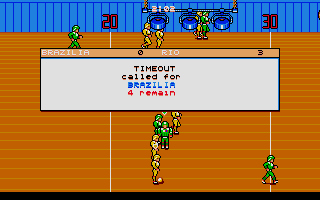
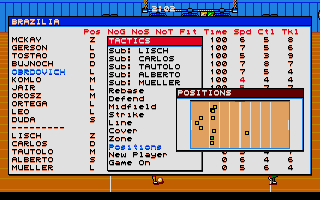
The quarter-based structure changes how a match breathes. Four 15-minute periods and a time-out system mean a bad spell is not necessarily something you just endure until halftime. Calling time-out lets you substitute or alter the tactical system, so there is a tangible response available when the current approach is failing. That is a smart fit for a sport that combines indoor rebounds with a more Americanized match structure.
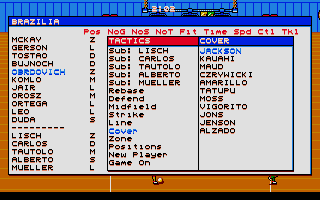
There is also enough management around the fixtures to make a chosen club feel like more than a shirt color. You choose the next lineup, handle transfers between seasons, and work with athletes whose statistics affect their performance, including duels. It is not a pure management game, but these decisions matter because a roster’s strengths feed back into the action. Winning the American or European league to reach the championship supplies a clear season-long target.
Graphics
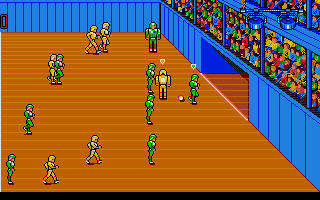
The side-view matches keep the ball, players, and enclosing walls in the same frame, which suits a game where rebounds are constantly part of the play. Helmeted athletes are an immediate, unusual sight for a soccer game, and the future-sport idea comes across plainly without getting in the way of following the action.
Story
There is no character drama pulling you through ProSoccer 2190. Its story is the season: choose one of 16 fictional teams, compete in either the American or European league according to that team’s origin, and earn a place in the championship.
The futuristic setting earns its place through the rules rather than through a pile of exposition. Helmets, indoor walls, time-outs, and quarters turn the familiar goal-scoring race into a believable alternate version of the sport. You understand the world by playing its version of soccer.
That means the stakes stay clean and sporting. Your attachment comes from shaping the lineup, seeing player strengths affect results, and pushing through league competition—not from a scripted tale. For a sports game, that is enough, and the premise is unusual enough to give the season some character.
Overall Experience
ProSoccer 2190 is worth a look if regular soccer simulations feel too orderly for you. The walls make every possession less predictable, and the kick-mode cursor gives shots a welcome sense of responsibility. When both elements click, the game has a tense, back-and-forth quality that ordinary open-pitch soccer cannot quite match.
Its roughest point is also its central demand: you need to adapt to a ball that never politely leaves the field and to shooting that asks you to judge several variables at once. If you want instant, uncomplicated arcade scoring, that can feel demanding. Give it a few matches, though, and the extra rules start to feel like the point rather than clutter.
The management touches lift the whole package above a one-off exhibition game. Transfers, lineup calls, athlete statistics, and tactical time-outs make league progress feel earned, while the championship chase gives the season a proper finish line. For more background on the game, its ProSoccer 2190 history and release information is useful. This is a focused recommendation for retro sports fans who want a genuine rules twist, not merely a future coat of paint.


Reviews
There are no reviews yet.