 Retro Replay Retro Gaming History, Reviews & Emulation
Retro Replay Review
Gameplay
The first few screens make their intentions clear: this is Repton 3 again, not a dramatic departure from it. You guide Repton through compact, self-contained puzzle stages, and the pleasure comes from working out how each screen’s objects and enemies fit together. If the original’s blend of direct control and careful puzzle solving already has its hooks in you, forty fresh screens is an immediately persuasive offer.
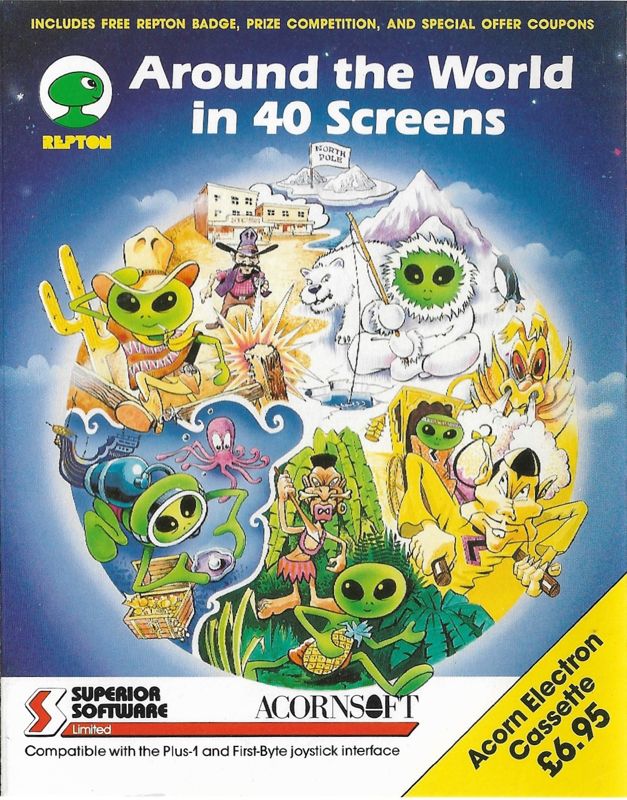
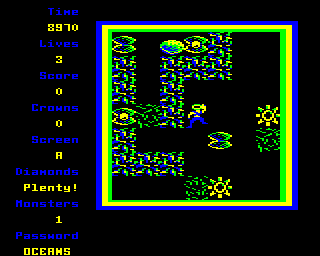
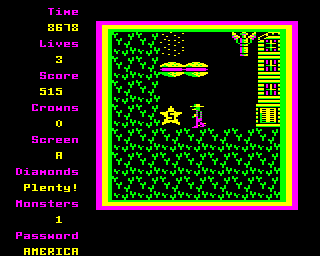
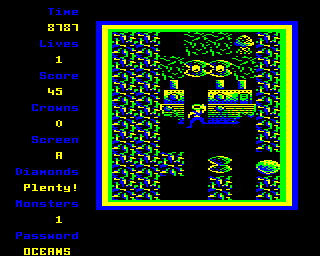
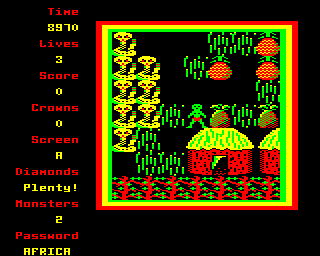
What starts to click is the way the travelling theme keeps the familiar formula from feeling entirely recycled. America, the Arctic, the Orient, the oceans, and Africa divide the levels into five distinct batches, so moving on means seeing a new set of thematic substitutions rather than simply another anonymous board. Hamburgers stand in for diamonds in America, while fish take their place in the Arctic. That is cosmetic at its core, but in a game built around discrete screens, a good change of scenery matters.
The limitation is equally plain: this expansion depends heavily on your existing affection for Repton 3. The gameplay is explicitly the same, and the new levels were made with the original game’s map editor. That need not mean they are lesser—handmade editor levels can be exactly what a veteran wants—but anyone hoping for new systems or a radically changed challenge will find a familiar framework wearing a travel costume.

Graphics
The BBC Micro graphics use themed replacements to make each destination legible at a glance. American stages trade diamonds for hamburgers and include Indians and bandits; Arctic screens bring in fish, polar bears, penguins, snowmen, and an Eskimo version of Repton. In the African set, coconuts replace boulders, while the ocean stages use octopuses and squids.
Repton’s costume changes help carry the joke from set to set: sheriff in America, Eskimo in the Arctic, kung-fu master in the Orient. These are small sprite-level changes, yet they give the forty screens more character than a standard collection of extra maps.
Story
There is no sprawling narrative to pull you from one screen to the next. Instead, the world tour is the game’s light framing device: five regions, each with its own object swaps, enemies, and version of Repton. It is enough to make the journey feel organized rather than like forty unrelated puzzles.
That restraint suits the format. A sheriff, an Eskimo, and a kung-fu master are not deep character arcs, but they establish the intended playful tone quickly. The game treats travel as a sequence of costume changes and themed hazards, which is more charming than consequential.
If you want a more story-led trip around the globe, look instead at Around the World in 80 Days. Around the World in 40 Screens is interested in giving you another puzzle screen to solve, not in stopping to explain the voyage.
Overall Experience
Around the World in 40 Screens succeeds because it does not overreach. It takes a proven Repton 3 structure, supplies a meaningful batch of new stages, and gives each group enough themed dressing to maintain a sense of progress. For an expansion pack, that is a sensible and satisfying recipe.
The strongest recommendation goes to returning Repton 3 players. You get more screens built in the same style, and the familiarity means you can settle into the challenge straight away. The world-tour wrapper is a bonus rather than the reason to play, but it is a welcome one.
Newcomers should start with Repton 3 itself, since this is an add-on built around its established gameplay. Once that style clicks, though, this forty-screen detour is worth taking: a modest, cheerful extension that understands exactly what its audience came back for.


Reviews
There are no reviews yet.