 Retro Replay Retro Gaming History, Reviews & Emulation

Retro Replay Review
Gameplay
The first few innings are easy to enjoy because Bases Loaded ’96: Double Header refuses to overcomplicate baseball. Batting comes down to reading the incoming pitch and timing the swing, while pitching asks you to place the ball where you want it. You can get into a game immediately rather than spending time wrestling with elaborate controls, and that directness suits a quick exhibition match.
That simplicity has a cost. Pitching offers little beyond choosing the pitch location, and batting is fundamentally a timing test. When you are in a groove, the clean back-and-forth between mound and plate has a brisk arcade-like rhythm. When the timing is not clicking, there is not much room to adjust your approach beyond trying to read the ball better and swing at the right moment.
Automatic fielding is a useful option because it lets you decide how much attention you want to give the defensive side. Turn it on if your priority is the pitcher-hitter duel; turn it off if you want to handle more of the action yourself. That choice does not transform the game, but it helps tailor the experience for a relaxed game or a more hands-on one.
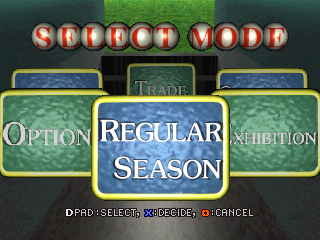
The mode selection does more heavy lifting than the basic mechanics. Exhibition is the right place to test the feel, while Regular Season gives you 13-, 26-, 52-, and 162-game schedules to suit your patience. A short schedule makes more sense here unless the uncomplicated play really grabs you. Trades also add a small but welcome reason to think about a team beyond a single game.

Graphics
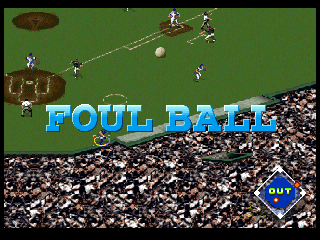
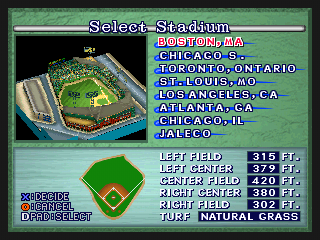
At the plate, the camera sits behind the batter; on the mound, it moves behind the pitcher. Those viewpoints keep the ball’s path central and make the game’s two key timing tasks easy to read. You can choose from seven MLB ballparks plus an extra Jaleco-designed park, giving the schedule a little venue variety.
Story
There is no scripted drama to lean on here. The closest thing to a story is the one you make through a season: deciding how long a schedule you can realistically commit to, changing the roster with trades, and trying to carry that club into a championship series.
Using real MLBPA players from the 1994 season gives those choices some recognizable baseball context, even though teams are identified by their cities rather than full team names. That makes roster tinkering more interesting than it would be with anonymous players, particularly if you enjoy revisiting that era of the sport.
The championship options are a sensible shortcut when you want stakes without a full season. A three-game series is ideal for a quick competitive run, while five and seven games give the limited on-field formula more time to breathe. Do not expect a narrative campaign; expect a lightweight framework for creating your own pennant race.
Overall Experience
Bases Loaded ’96: Double Header is most enjoyable in short sessions, when its straightforward pitching and batting feel like a virtue instead of a limitation. Pick it when you want to play baseball right away, not when you want a deep simulation built around detailed control at every position.
The long-season options and trades give it more staying power than a bare exhibition game, and the championship formats are a nice middle ground for anyone who wants a defined goal. Still, the core loop remains very narrow. A 162-game season is hard to recommend unless you genuinely love its timing-based approach at the plate and simple targeting from the mound.
At 5.6, this lands as a middling but usable mid-1990s baseball game. It is worth a chance for a fan of the period, for someone who wants recognizable 1994 players, or for anyone who values uncomplicated couch-style baseball. If you need richer pitching decisions and more involved batting, its early accessibility will likely turn into frustration before the season gets interesting.


Reviews
There are no reviews yet.