 Retro Replay Retro Gaming History, Reviews & Emulation


Retro Replay Review
Gameplay
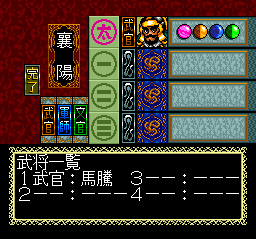
The first hour of Eiyū Sangokushi has an easy pull because it does not bury you under the usual Three Kingdoms complexity. You choose a warlord and capital, look at the cities around you, and start building enough strength to make an attack worthwhile. The loop is immediate: improve your lineup of generals, compare your position with a neighboring city, then try to expand.
That simplicity makes it approachable, especially beside the denser strategy games built around the same historical period. You are not being asked to micromanage a sprawling empire before anything interesting happens. Instead, the game pushes you toward clear decisions about where to apply your strength next, and the campaign moves at a useful clip.
The limitation becomes obvious once you want more control. Battles are automatic, so much of the tension comes down to statistics and whether your generals are strong enough rather than clever maneuvering on the field. A powerful roster is the answer to many problems, which can make victories feel predetermined and setbacks feel like a reminder to raise better numbers.
Eight scenarios give the game a decent spread across the era, and the map-construction option is a welcome extra for anyone who wants to set up a different contest and take command of another available character. It is replayable in the way a compact board game is replayable: you come back for a new starting position, not because each match uncovers a deeper layer of tactics.

Graphics
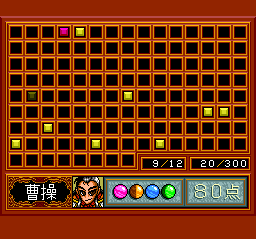
The famous warlords appear as super-deformed, big-eyed anime portraits rather than stern historical figures. It is a deliberately comical look for a game about the Three Kingdoms, and it helps separate Eiyū Sangokushi from more solemn takes on the period.
Story
This is a light-hearted run through the Three Kingdoms period, not a dramatic retelling that asks you to follow a long scripted narrative. The historical frame gives your conquest a sense of place, while the playful character art keeps the tone from becoming overly weighty.
The scenarios begin with Dong Zhuo’s rise to power late in the second century and extend through the final struggle involving Cao Cao’s sons and the destruction of the three kingdoms. That range is meaningful because it lets you enter the period at several points rather than treating it as one fixed campaign.
Still, the history functions chiefly as the backdrop for territorial strategy. If you know and love the period, familiar names and changing scenario starts will add flavor. If you are hoping for an involved historical drama, the game is much more interested in putting a warlord in your hands and letting you push outward from a capital.
Overall Experience
Eiyū Sangokushi is a modest, accessible alternative to heavyweight Three Kingdoms strategy. Its best quality is clarity: you can understand what matters quickly, make a plan, and see whether your growing group of generals is enough to take the next city.
That same clarity caps its staying power. Once you recognize that automatic battles and stat comparisons drive much of the outcome, there is less room for the kind of battlefield ingenuity that makes deeper turn-based strategy games so satisfying. Frustration is most likely to set in when you want to outthink a stronger opponent but largely need stronger numbers instead.
The payoff is still worthwhile if you want a breezy historical strategy game with an unusually cheerful anime slant. It is less convincing as a serious simulation of the Three Kingdoms, but it has a straightforward charm and enough scenario variety to reward a few campaigns. Fans of elaborate strategic control should skip it; anyone curious about a lighter conquest game may find it pleasantly unfussy.


Reviews
There are no reviews yet.