 Retro Replay Retro Gaming History, Reviews & Emulation



Retro Replay Review
Gameplay
The first hour’s pull comes from having a clear job, losing the person you were supposed to protect, and being sent into a familiar RPG loop with a reason to care. You guide Kearu’s party across a top-down world map, run into random enemies, earn experience and money, then spend that money on stronger gear and useful items. None of that is trying to reinvent the genre, but the structure is dependable if you enjoy settling into an old-school rhythm.
Combat is turn-based and built around the expected HP and MP economy. Characters gain attack, support, and healing magic through leveling, so progress is tied to both surviving battles and gradually widening your options. That makes the early going easy to read: fight, improve, equip, and push farther. If you like RPGs where steady character growth is its own reward, Tenshi no Uta has a solid foundation.
The day-and-night cycle is the mechanic most likely to interrupt your momentum in an interesting way. Shops closing at night means a badly timed arrival can delay your preparations, while some characters only appear at particular times of day. It is a modest piece of scheduling rather than a major simulation, but it asks you to pay attention to the clock instead of treating every town visit as interchangeable.
Frustration will depend largely on your patience for random battles and conventional progression. The game does not hide that it wants you to spend time fighting for levels and cash. Go in wanting a traditional RPG routine, not a brisk adventure that constantly changes its rules, and the repetition is easier to accept.

Graphics
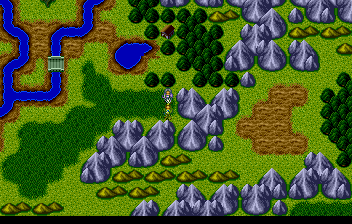
Exploration uses a top-down view, while battles place enemy artwork over the exploration screen from a first-person perspective. It is an unusual switch: you move through the world from above, then face monsters directly when combat begins. The battle view keeps attention on the enemy rather than on animated party members.
Story
Kearu and Krea’s relationship gives the opening more weight than a generic royal delivery. Kearu has been entrusted with protecting a girl found abandoned near his village as a baby, so her abduction feels like a failure of his responsibility as well as the event that launches the quest.
The winged monster’s attack also points the story beyond the missing magic flower. Kearu quickly understands that Krea was taken for a reason, and that her mysterious origin is part of it. That is a familiar fantasy setup, but it is an effective one: the game puts a question in front of you early and gives the journey a personal center.
Do not expect the premise to operate outside classic Japanese RPG territory. A young warrior, a threatened companion, magic, a king, and a hidden past are all recognizable ingredients. Still, the kidnapping gives the adventure a more immediate drive than a simple fetch quest would have had, and Krea’s identity is the thread most likely to keep you moving onward.
Overall Experience
Tenshi no Uta is for the mood where you want a traditional fantasy RPG without needing every system to surprise you. Its pleasures are uncomplicated: wandering the map, weathering encounters, seeing your party become stronger, buying upgrades, and following a rescue story with a lingering mystery at its heart.
The game asks for some tolerance of genre habits. Random encounters and leveling are not side activities here; they are central to the pace. In return, you get a clean progression loop and a day-night system that gives towns a little extra texture beyond being simple rest-and-shopping stops.
If you are drawn to early Japanese RPG design, the payoff is the comfort of a familiar journey sharpened by Krea’s disappearance and the question of who she really is. If repetitive battles and routine resource building drain you, that same traditional structure may wear thin. For the right kind of RPG fan, though, this is an easy game to meet on its own terms.


Reviews
There are no reviews yet.