 Retro Replay Retro Gaming History, Reviews & Emulation
Retro Replay Review
Gameplay
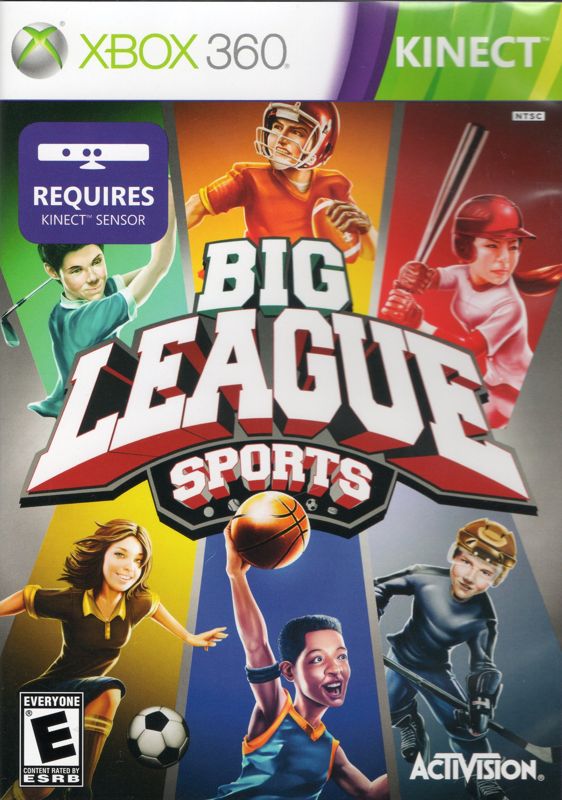
The first few minutes have the uncomplicated charm you want from a Kinect sports game. You are immediately swinging for home runs, firing at baskets, kicking field goals, or flinging yourself into a blocking pose. Big League Sports keeps the rules simple enough that somebody can walk in, watch one turn, and understand what to do on the next. That makes it a solid fit for an active group that would rather laugh at a missed catch than study a controller layout.
The best decision is giving each sport both quick score-chasing events and a larger “Big League” event. Baseball moves from home-run hitting and catching to pitching and batting; golf goes from driving into trampolines and putting to a course round with terrain and wind; the other sports similarly branch into shooting, blocking, running, dodging, or scoring. That variety stops the collection from feeling like the same motion repeated with a different ball. The driving contest in golf and the directed ball movement in events such as home runs and field goals also add a little mid-flight correction to the basic swing or kick.
Still, the depth is deliberately light. The full events ask you to run, dodge, and score, but they remain mini-game interpretations of their sports rather than detailed simulations. A one-player session can start to feel repetitive once you have sampled each event and learned its rhythm. Bring three other people, select a three-event mini-tournament, and the format makes much more sense: short rounds, changing sports, and plenty of chances for one strong performance to swing the result.
Some events demand bigger whole-body actions than others. Catching fly balls, stopping shots as a goalie, and blocking basketball throws turn your body into the input device, while golf and baseball lean harder on the timing of a swing. If you enjoy Kinect games most when they ask you to get off the couch and commit to the gesture, that mix works. If you want exact, repeatable sports control, the movement-heavy design can become a source of irritation.
Graphics
The game puts its sports in clear, familiar spaces: a baseball hitting area, basketball court, football field, golf course, hockey arena, and soccer field. In-game opponents give the blocking, dodging, and scoring challenges something tangible to react to, while the golf course is the most visually specific setting thanks to its terrain and wind-aware shots.
On the Xbox 360, the camera needs to keep your target and your moving character in view during the larger sport events. The action is easy to parse because each challenge focuses on a ball, goal, opponent, or landing area instead of crowding the screen with extra detail.
Story
Big League Sports has no narrative hook to carry you from event to event. Its “story” is the familiar sports-game arc in miniature: make the catch, beat the goalie, dodge the defender, reach the end zone, then try to post the better score.
That is not necessarily a problem for a party collection. A football toss or hockey goalie round creates its own tiny moment of pressure without needing setup, and a three-event tournament supplies a clean beginning, middle, and finish for an evening with friends.
Solo players should not expect those small competitive scenarios to grow into a larger tale. The motivation is immediate performance: hit farther, react faster, and score more points. It works when you are chasing another person’s result; it is less compelling when you need a continuing reason to return.
Overall Experience
Big League Sports is easiest to recommend as a low-stakes Kinect party game. Six sports and eighteen events sound broad because they are broad, but the meaningful advantage is how quickly it can move a group from baseball to basketball to golf without anyone needing to learn a new complicated ruleset. The mini-tournament option is the feature that turns that assortment into a proper shared session.
Its limitations are equally clear: every sport is condensed into broad actions and brief objectives. That can be refreshing after a dense sports simulation, but it also means the game depends heavily on the energy in the room. With friends trading turns, the short events are a strength. Alone, they are more likely to feel like a sampler than a destination.
If you are building a Kinect library around active local multiplayer, this is worth considering beside Big League Slugger Baseball, another game carrying the Big League name. Give Big League Sports a chance when you want approachable, body-driven contests across several sports. Skip it if your priority is deep season-style play or precision-first competition.


Reviews
There are no reviews yet.