 Retro Replay Retro Gaming History, Reviews & Emulation
Getting an emulator onto a Dreamcast in 2001 meant making a disc before you could play a game. The files had to be arranged correctly, and the instructions had to match your console and burner. Sega’s commercial future for the machine was narrowing, but people testing emulators, homebrew tools, and bootable discs were still finding new uses for it. First, they had to get the thing to boot.
On a PC, you could usually download an emulator and open it on the same machine. The Dreamcast put a few more obstacles between you and your favorite game. Even a successful boot might lead to missing sound, broken saving, or the wrong video mode. Getting as far as the title screen could feel like a small victory. Playing comfortably for an evening was another challenge.
Players who came looking for games could find themselves learning how to build a disc, why an emulator lacked a feature, or where to find its source code. The route from fan to tinkerer was sometimes just one stubborn problem long.
NesterDC: an NES inside Sega’s last console
The Nintendo Entertainment System gave Dreamcast programmers a promising place to start. Players knew how its games should look and sound, and there was already a mature body of NES emulator work to study and adapt. But desktop code did not arrive ready for Sega’s console. Controllers, television output, storage, and the business of getting the program onto a disc all needed attention.

DCEmulation’s preserved NesterDC release list dates NesterDC 1.0 to February 20, 2001. Version 2.0 followed on March 14, then 3.0 on June 3. There was another release on November 8, followed by 5.0 on December 3. Dreamcast owners had several chances that year to burn a new disc and see what had improved.

The June 3 Retrogames report shows what version 3 offered. Sound was described as close to perfect, the game menu worked better, and the emulator ran noticeably faster than version 2. A new option could boot straight into a file named GAME.NES, making a single-game disc feel more like a dedicated NES cartridge. The source code was released too. For players, the improvements were easy to appreciate: less time navigating, faster games, and sound closer to what they remembered.
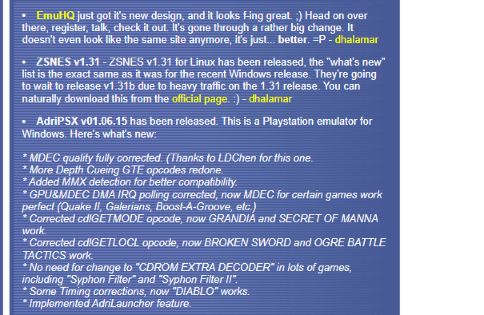
That report also credits Dave Arnold, who supplied artwork for the menus and maintained the NesterDC site at Emulation64. Menu art might sound like a finishing touch, but this was software people used from across the room, with a controller in hand. Finding the right game on a television was part of the experience. Arnold helped make that first encounter more welcoming.
Version 3 still had limits: a disc menu could hold no more than 2,048 games, and filenames were capped at 128 characters. Generous as those numbers might sound, players preparing a disc still had to work within them.
NesterDC began with Ken Friece. According to the community’s archive, Takayama Fumihiko took over after Friece left toward the end of 2001. Keeping the project going meant continuing to deal with hardware quirks and players’ requests, as well as the code itself. Takayama’s later releases would make NesterDC a fixture of Dreamcast emulation; that work lay beyond this first year’s run of updates.

Ken Friece Ken Friece started NesterDC, the NES emulator that helped make the Dreamcast feel like a new home for older games.
Takayama Fumihiko Takayama Fumihiko continued NesterDC after Ken Friece stepped away, carrying a promising Dreamcast NES emulator into its next phase.
The attraction was simple enough once the disc worked. A ROM collection that had kept you at a PC could now be played on a television with a console controller. Familiar NES games had found an unexpected home inside Sega’s machine. After all the file preparation and version checking, you could finally sit down and play.
Sintendo and the promise of SNES on Dreamcast
The Super Nintendo asked more of the Dreamcast. Jamin Vander Berg, known as Sin, worked on Sintendo, a port of Snes9x built with the Windows CE development tools available for Dreamcast. DCEmulation’s project page dates its final listed pre-release to August 3, 2001, and records two substantial gaps: no sound and no saved games. Getting a SNES game running was an achievement. Settling in with a long RPG was a harder proposition when you could neither hear it nor save your progress.
Jamin Vander Berg (Sin) Jamin Vander Berg, known as Sin, brought Snes9x to Dreamcast as Sintendo and spoke candidly about the compromises.
The original computer emulator remains in Retro Replay’s Snes9x directory. Sintendo was a separate Dreamcast port of that code, with its own limits and audience.
Developers put incomplete builds out for others to test, and players learned to check the version notes before burning a disc.
Another Snes9x-based project, DreamSNES, offered players more of the Super Nintendo experience. The DCEmulation record credits Marcus Comstedt, Peter Bortas, and Per Hedbor and documents a project with a substantial afterlife. Its release notes also show how much work went into the parts a player encountered before a game even started.
Marcus Comstedt Marcus Comstedt helped create DreamSNES with Peter Bortas and Per Hedbor, bringing a fuller SNES experience to the Dreamcast.
The team’s own release notes date version 0.9.4 to March 12, 2001. It added full-screen mode, better menu key repeat, keyboard support, improved handling for some third-party memory cards, and new music by Jan Warnstam. There was no dramatic speed leap, but there were fixes to make choosing and playing a game less awkward. The developers also joked that people had probably heard enough of the Christmas song from their December build. By March, a change of menu music seemed fair.
Kathy Choi made the artwork, Warnstam supplied menu music, and Daniel Wressle had contributed that holiday track. Testers, translators, and people helping users make discs rounded out the work of the three core authors. In 2001, DreamSNES could play Super Nintendo games on Sega’s console with sound and saves, though games often ran below full speed. Sintendo lacked those two features, so players had different compromises to weigh. DreamSNES’s SH-4 assembler rewrite would follow in 2002.
A race nobody had to declare
In a late-2001 interview preserved by Dreamcast Wiki, Jamin Vander Berg (Sin) explained why he had started with Snes9x: much of it was written in portable C, making it easier to adapt to another machine. ZSNES relied heavily on x86 assembly, code tied to a different processor that would have needed much more rewriting for Dreamcast. An emulator that worked well on a PC could still be a difficult starting point for a console port.
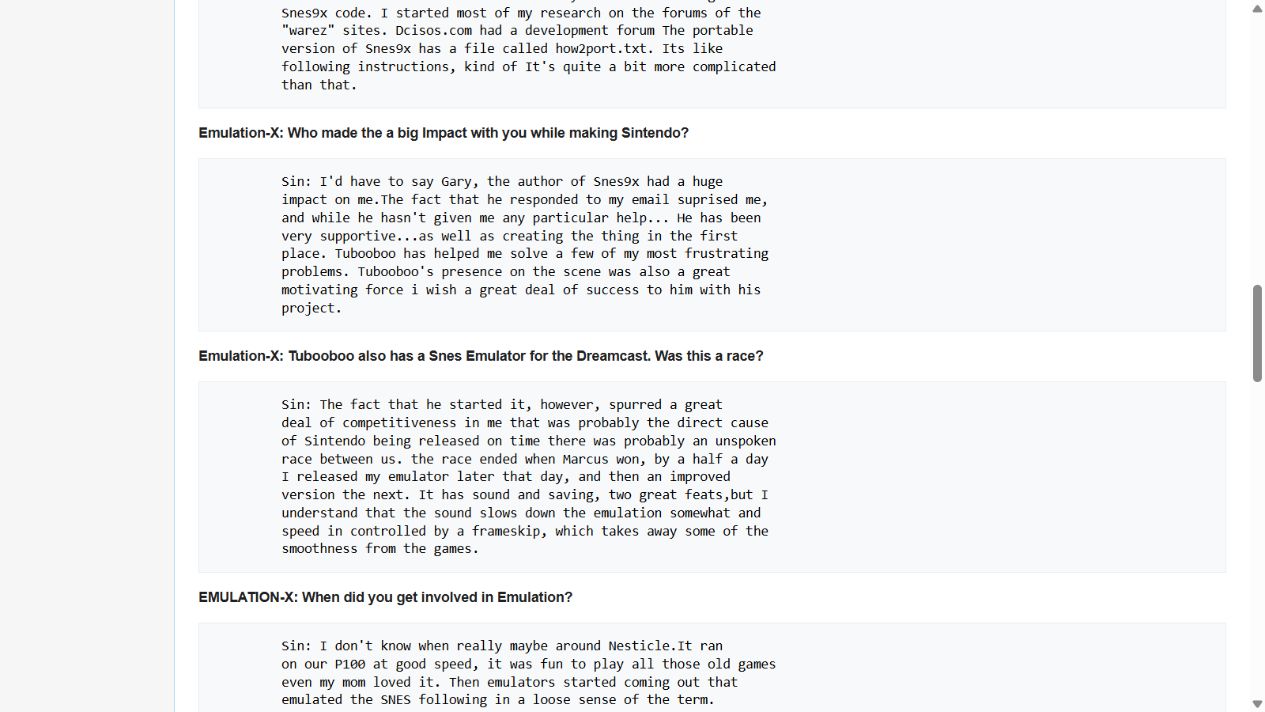
Sin recalled an “unspoken race” with the other Super Nintendo effort. In his account, Marcus Comstedt released his emulator roughly half a day before Sin put out Sintendo later that day. He credited Gary Henderson, whose Snes9x work made the port possible, and Tubooboo, whose encouragement and development work helped spur him on. Even the name came from someone else: his web designer, Spankthemonkey, came up with Sintendo.
The interview does not read like a bitter rivalry. Sin acknowledged that DreamSNES had sound and saving while discussing the performance tradeoffs. He wanted Sintendo to run faster, and hoped eventually to hear the music in Chrono Trigger while he played.
By the interview, Sin had spent more than a year on Sintendo. He also wanted to make games of his own, and knew how readily the emulator could swallow his spare evenings. In a later message reproduced on the same page—not a 2001 shutdown announcement—he said he was satisfied with how far he had come but unsure whether he could continue. The unspoken race still had to fit around jobs, other ambitions, and the time its developers could give it.
More than Nintendo on a Dreamcast
Nintendo games were only part of what people were trying to fit onto a Dreamcast. In late January, Retrogames reported DreamMSX 0.2b and then 0.2f, bringing the Japanese MSX computer family into the living-room experiment. The news writer wished he owned a Dreamcast and a CD burner so he could try it. Even following the releases could be tantalizing: one console might open up a computer’s library, but joining in still meant having the gear to make the disc.
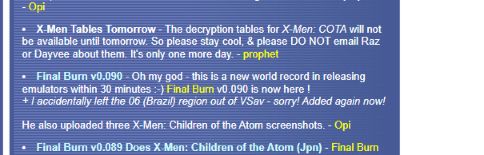
DreamSpec brought the Sinclair Spectrum to Sega hardware. The January archive identifies version 0.0003 and links to an interview with its team. The prospect of Spectrum games on a Dreamcast was appealing, even with the project still finding its feet.
Sega’s own Genesis/Mega Drive was also in the picture. In January, DCEmulation featured an interview with DreamGEN programmer TwinD, while a separate post showed a graphical interface for the still-unreleased emulator. Readers had a menu to look at, but no build to burn and test yet. Whether it could run Sonic smoothly remained a question. For now, following the project meant waiting.
Getting each of these machines onto the Dreamcast meant tackling a different set of problems. The MSX, Spectrum, Genesis, NES, and Super Nintendo each had their own timing, sound, graphics, and input behavior. Those differences reached right into the player’s hands: the Dreamcast controller suited some games and felt awkward with others.
The same experiments were spreading to other new hardware. The June Retrogames archive recorded ZX Advance, a Spectrum emulator hosted at Emulators Unlimited for the brand-new Game Boy Advance. While DreamSpec put the Spectrum on a living-room console, ZX Advance offered another destination: a handheld.
Even NES players had more than one route onto Sega’s machine. Alongside NesterDC, ReGex released FrNES, based on the earlier pNesX work by Racoon. DCEmulation’s project record dates version 0.60 to December 24, 2001. Its Christmas Eve release brought scrolling and sound improvements, support for more mappers—the cartridge hardware some games depended on—source code, and disc-swapping repairs. These were the fixes a player could appreciate long after the novelty of “NES on Dreamcast” wore off. A shaking background, grating audio, or an unsupported cartridge could spoil the evening; another developer’s approach gave players another option.
Other programmers were working in the opposite direction: getting the Dreamcast itself to run on a PC. DCEmulation lists DreamEmu 0.03 on August 3, 2001, an early build by Lord Cheese. It could run some homebrew and technical demonstrations, but no retail games. Anyone downloading it in hopes of playing Sonic Adventure on a desktop would have to wait. At this stage, the work was about getting small programs to boot and learning how Sega’s hardware behaved.
The websites that made a disc possible
For players trying these programs on a Dreamcast, downloading the emulator was only the beginning. They had to navigate boot discs, disc images, self-boot methods, and scrambled executables, then work out whether a failure came from the emulator or the way the disc had been burned. DCEmulation‘s forums and guides gave them somewhere to turn. The community’s own history dates the site’s founding by 007Cheater to September 25, 2000. By 2001, the site was growing into a place where people could learn how to get these experiments running.
007Cheater 007Cheater founded DCEmulation and opened a developer site in 2001 that helped curious Dreamcast owners start making things.
A release page might supply plain files for someone assembling a custom disc, alongside a prepared image for someone who just wanted to try the program. When neither worked, forum members could help narrow down the problem by asking about the console revision, the files, the burning method, and what appeared on screen. That exchange could save the next reader an evening of wasted discs. DCEmulation connected players and programmers through the people willing to explain the fiddly steps between a download and a running game.
The site’s own account, written later, describes the forums as a gathering place for Dreamcast homebrew developers and says the site hosted projects as well as news. The surviving project pages give that recollection a practical shape: older releases sit alongside source files, tutorials, and interviews. A visitor following NesterDC, Sintendo, or DreamSNES could trace the attempts and revisions that led to a release, rather than finding only the final download.
007Cheater also opened a separate Dreamcast Developer site on June 9, 2001. In its welcome post, he described a place where new developers could learn what programming for the console required. The opening page pointed toward toolchains, libraries, disc creation, demos, and tutorials; the next day’s post was already puzzling through Dreamcast Linux. It felt like somebody putting up a workbench and inviting other people to learn beside him. A visitor who had no idea what an SH-4 was had somewhere to begin.
Players and programmers needed different kinds of help. A player wanted to prepare a disc and choose a release that worked with the hardware at home. A future programmer needed to compile a small example, get it onto the console, and work out what had gone wrong when it failed. DCEmulation made room for both. Someone could arrive looking for NesterDC and find the tools and advice to try making something of their own.
DCEmulation’s community work extended beyond downloads and technical help to staffing the site, changing its design, and arguing about what belonged in the scene.
A 2001 game in Retro Replay GameBase
Sony buys the emulator it had fought
Commercial emulator users faced a question that no installation guide could answer: would the software they bought still be sold? In 2000, the Ninth Circuit had ruled in the Sony v. Connectix dispute that intermediate copying to understand a system could be fair use under the facts of that case. It was an important ruling for software reverse engineering, but it did not settle the future of Connectix Virtual Game Station, the commercial PlayStation emulator for Mac and Windows.
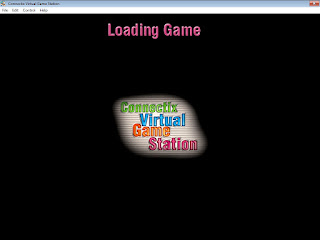
On March 14, 2001, Sony and Connectix announced a joint technology agreement that ended their dispute and transferred assets related to Virtual Game Station to Sony. Macworld’s report on the announcement captured the surprise of former courtroom opponents becoming business partners. In a follow-up interview with Connectix president Roy McDonald, McDonald described the agreement as broader than one emulator. That public account offered no assurance that Virtual Game Station would thrive under Sony ownership.

Connectix had won an important appellate ruling, yet its commercial product now passed into the control of the console maker it had challenged. Sony reached an agreement over this particular product and its technology without needing a new ruling against emulation. Developers watching the deal could see the gap between a right to reverse engineer and the ability to keep selling the program built from that work.
For players, VGS had made the Macintosh an unexpected place to put a PlayStation disc. Aaron Giles and the Connectix engineering team had helped make that possible, as described in earlier chapters. Now the software’s future depended as much on a business agreement as on their programming. Users who had invested in VGS, and developers who had invested in its future, were left waiting on decisions behind that agreement.
bleemcast! reaches players, then bleem! closes
While Virtual Game Station changed hands, bleemcast! was trying to bring PlayStation games to Sega’s Dreamcast. The player would buy a Dreamcast emulator disc, then supply the original PlayStation game disc for the specific title it supported. The first announced retail target was Gran Turismo 2. In an April 20, 2001 contemporary report, GameSpot described the planned swap from the key disc to the game disc, along with the company’s intention to follow with Tekken 3 and Metal Gear Solid.
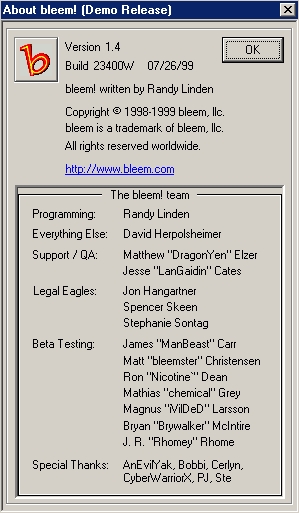
All three bleemcast! products eventually reached players: discs for Gran Turismo 2, Tekken 3, and Metal Gear Solid. Each retail disc ran its named PlayStation game on a Dreamcast, so buyers had to match the emulator disc to the game they wanted to play. A striking Gran Turismo image could sell the dream, but it did not mean the rest of a PlayStation collection would work.
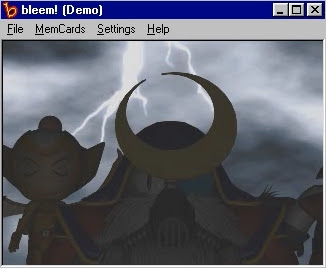
The company’s own FAQ, preserved by DCEmulation, explains how it arrived at that smaller lineup. The team had once talked about packs covering a hundred games. Months of testing persuaded it to concentrate on individual titles: there was no single fix that would bring every game up to console players’ expectations. A PC user might put up with a settings hunt or a glitch in one scene. Someone buying a disc for a Dreamcast expected to put it in and play. Getting a game to run was only part of the job.
The legal fight continued even after the discs reached buyers. A November 19, 2001 report said bleem! had closed. Its president, David Herpolsheimer, blamed the company’s financial exhaustion on repeated legal action by Sony. The report also described Sony’s claims that bleemcast! infringed its patents. Those were Sony’s allegations, not a reported court finding. The 2000 Ninth Circuit opinion in the earlier bleem case addressed different issues and did not settle this later dispute.
bleem! had made software people could buy and use, and had fought off attempts to stop its earlier sales. By late 2001, the company was gone. Readers following emulation news that year could see a bleemcast! release announcement and, months later, a goodbye notice. The next version depended on more than getting the code right: legal costs, distribution pressure, and the money a small company had left could decide whether work continued.
The scene’s physical infrastructure was a website
For most visitors, emulation arrived through a website’s front page: a headline, a link, a version number, perhaps an excited note from a webmaster who had tried the build. Zophar’s Domain, Retrogames, EmuUnlim, Emulation64, DCEmulation, and EmuParadise connected separate projects into a sprawling conversation. Keeping that conversation online took work. Webmasters needed servers, volunteer staff, enough capacity to survive a traffic spike, and rules about which downloads they would host.
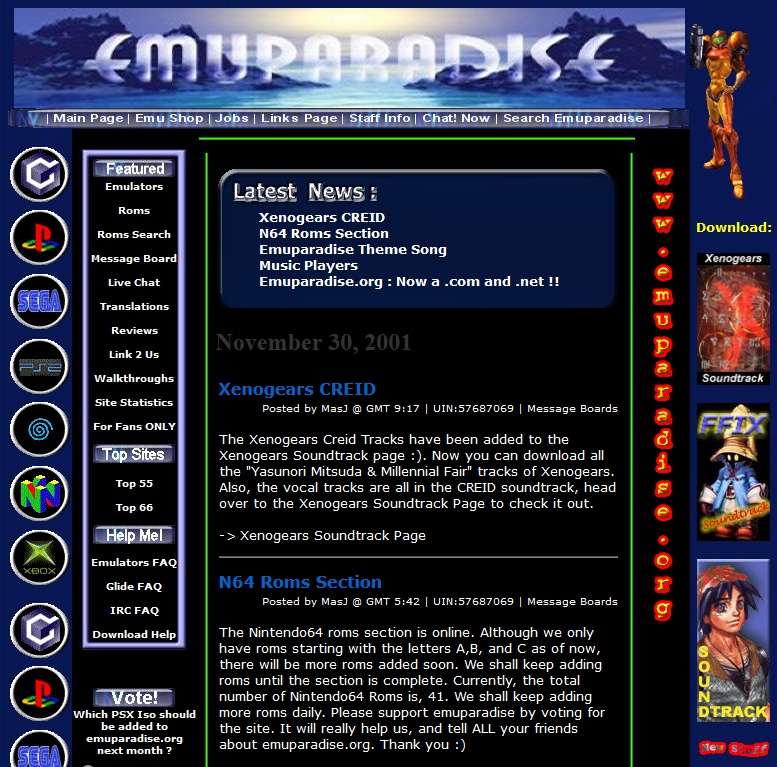
EmuParadise founder MasJ recalled that work in a staff history he wrote around 2002. After launching the site in March 2000, he struggled with free hosting, heavy traffic, sponsors who vanished, and stretches when the server was down. He remembered working on a redesign with Cypher in May 2001, but the unreliable server kept them from putting it online. Fellow staff member Magus recalls discovering the site in February 2001, joining its message boards during an outage, and seeing the site return more fully in August.
EmuParadise also offered ROM downloads—copies of games, distinct from the emulator software used to run them, even when both appeared under the same site’s navigation. That brought hosting risks and questions about what the site should distribute. In MasJ’s account, demand for access drove traffic beyond what a volunteer operation could afford or host. The message board gave people somewhere to keep talking while the main archive was down and the site was being rebuilt.
Other sites relied on a similar patchwork of hosts. A busy day in Retrogames’s June 2001 archive sends readers among project pages at Retrogames, Emulators Unlimited, Emulation64, MAMEWorld, and individual domains. One site might announce a build hosted on a second, with screenshots or documentation on a third. Sharing the load helped keep projects available, but a missing host could break the route to a download. Dead links were already a problem for the webmasters keeping software reachable, long before historians came looking.
The people writing those front pages helped set the mood. Retrogames urged readers to try NesterDC, complained about a leaked private Boycott Advance beta, and asked fans to leave a developer alone until a release was ready. News posters cheered projects on, made mistakes, corrected one another, and sometimes called out bad behavior first. Their enthusiasm could make a new emulator feel like an event. The same attention could leave a developer fielding demands for answers about work that was not finished yet.
A new Xbox fan site
Small fan sites were getting ready too. David Becker, posting as dmb062082, started Xbox Power before the console reached stores. An August 2001 capture shows it following Otaku no Zoku’s prospective MAME work; a September post announced the purchase of xb-power.com. Becker interviewed developers and followed their progress, joining the growing crowd curious about what the Xbox might run.
A world larger than the English-language portals
A reader looking for help in 2001 did not have to start with an English-language portal. Communities elsewhere had their own forums, guides, and arguments, often in their own languages. People asked questions, found software, and shared what they had learned; they were doing more than translating someone else’s headlines. Many of those pages are harder to find now, lost behind dead links, but they were working parts of the scene for the people who used them.
Sometimes the best place to ask was a site devoted to one arcade board or console. A CPS-2 page, a Dreamcast guide, or a Nintendo 64 plug-in forum could get much deeper into a problem than a large portal’s three-sentence release notice. Where those pages survive, their debates show parts of the scene that the best-remembered sites alone cannot capture.
Behind the year’s releases were people explaining how to burn a disc, keeping older versions available, answering the same beginner question for the hundredth time, and moving projects when a host went down. Their release notes, guides, interviews, and dated news pages preserve more than download links: they show how programmers and players kept these experiments alive.
People in this chapter
- Ken Friece — Ken Friece started NesterDC, the NES emulator that helped make the Dreamcast feel like a new home for older games.
- Jamin Vander Berg (Sin) — Jamin Vander Berg, known as Sin, brought Snes9x to Dreamcast as Sintendo and spoke candidly about the compromises.
- Marcus Comstedt — Marcus Comstedt helped create DreamSNES with Peter Bortas and Per Hedbor, bringing a fuller SNES experience to the Dreamcast.
- Takayama Fumihiko — Takayama Fumihiko continued NesterDC after Ken Friece stepped away, carrying a promising Dreamcast NES emulator into its next phase.
- 007Cheater — 007Cheater founded DCEmulation and opened a developer site in 2001 that helped curious Dreamcast owners start making things.
Sources and further reading
- DCEmulation NesterDC record
- DreamSNES original release page
- Sin’s Sintendo interview
- DCEmulation site history
- Dreamcast Developer site
- Sony and Connectix joint announcement
- bleemcast! FAQ
- GameSpot on bleem! closing
- MasJ’s EmuParadise recollection
Part of: The Complete History of Video Game Emulation
Browse biographies: People in the History of Video Game Emulation