 Retro Replay Retro Gaming History, Reviews & Emulation
A new emulator could be ready to download, only for its author’s host to hit a bandwidth limit and leave the link useless. In 2000, keeping a release within reach often fell to volunteers running hand-built websites with borrowed hosting and a daunting number of links. An emulator could be written in a bedroom, but players needed somewhere to discover it, try it, argue over it, and find the next version.
The work hidden behind an emulator headline
A release post looked simple enough: a version number, a handful of changes, and a download link. Before it appeared, someone had to hear from the author, check the file, upload it or find a mirror, write a description, and put it under the right system. Afterward, someone still had to keep the download reachable. An old build mistaken for a new release, a fake release, or a file that crashed on launch meant another job: correcting the post where everyone could see it.
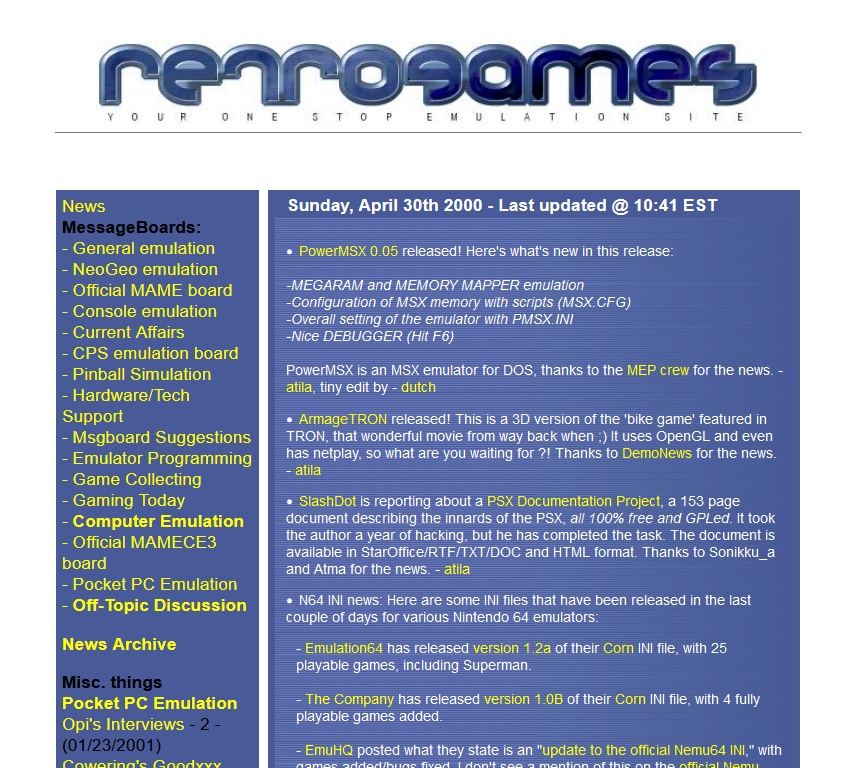
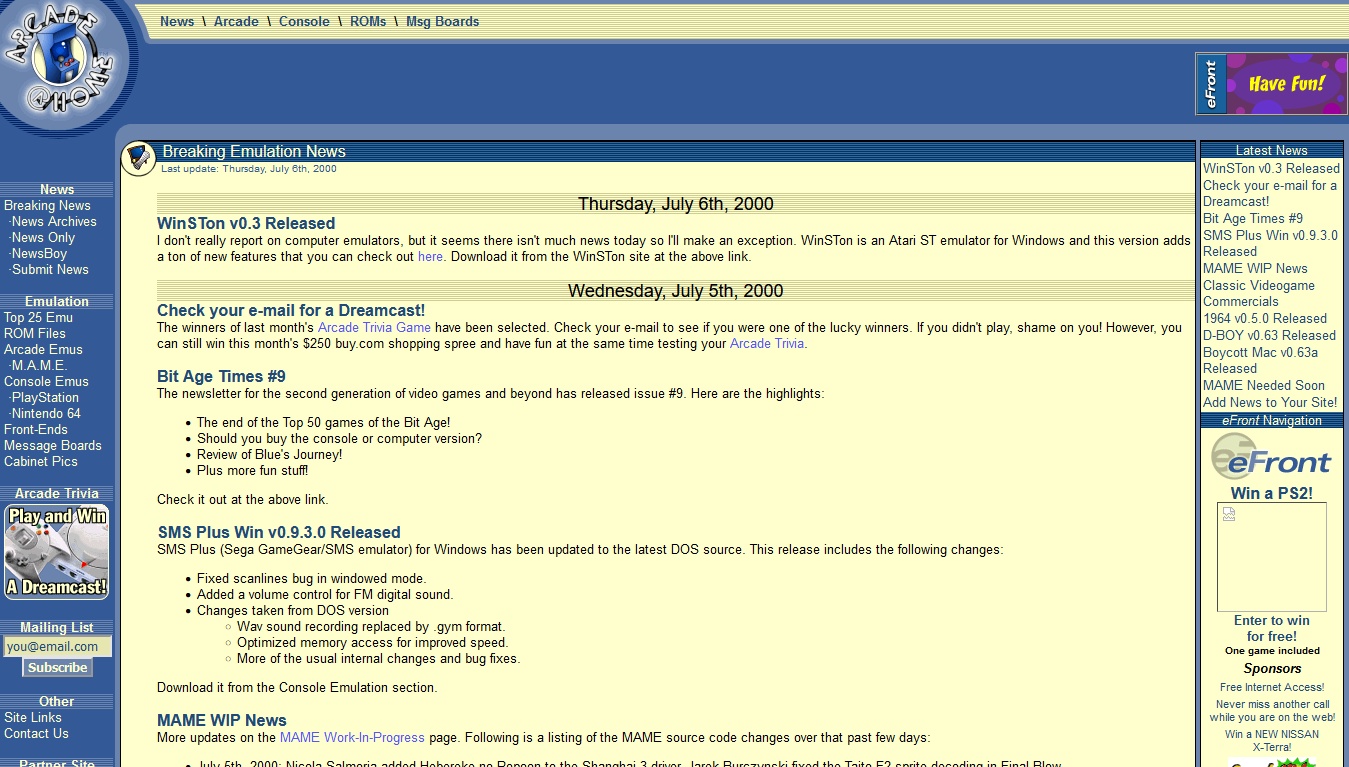
Sites such as Zophar’s Domain, Retrogames, EmuUnlim, EmuForce, Emulation64, and specialist pages formed an improvised distribution network. Each had its own approach. One built a download archive; another ran interviews; another collected technical documentation for a single console. They linked to one another, raced to post releases, and sometimes hosted the same developer’s files. A new version could appear on a small page and turn up across several portals by evening. Players had plenty of places to look, and plenty of paths between them.
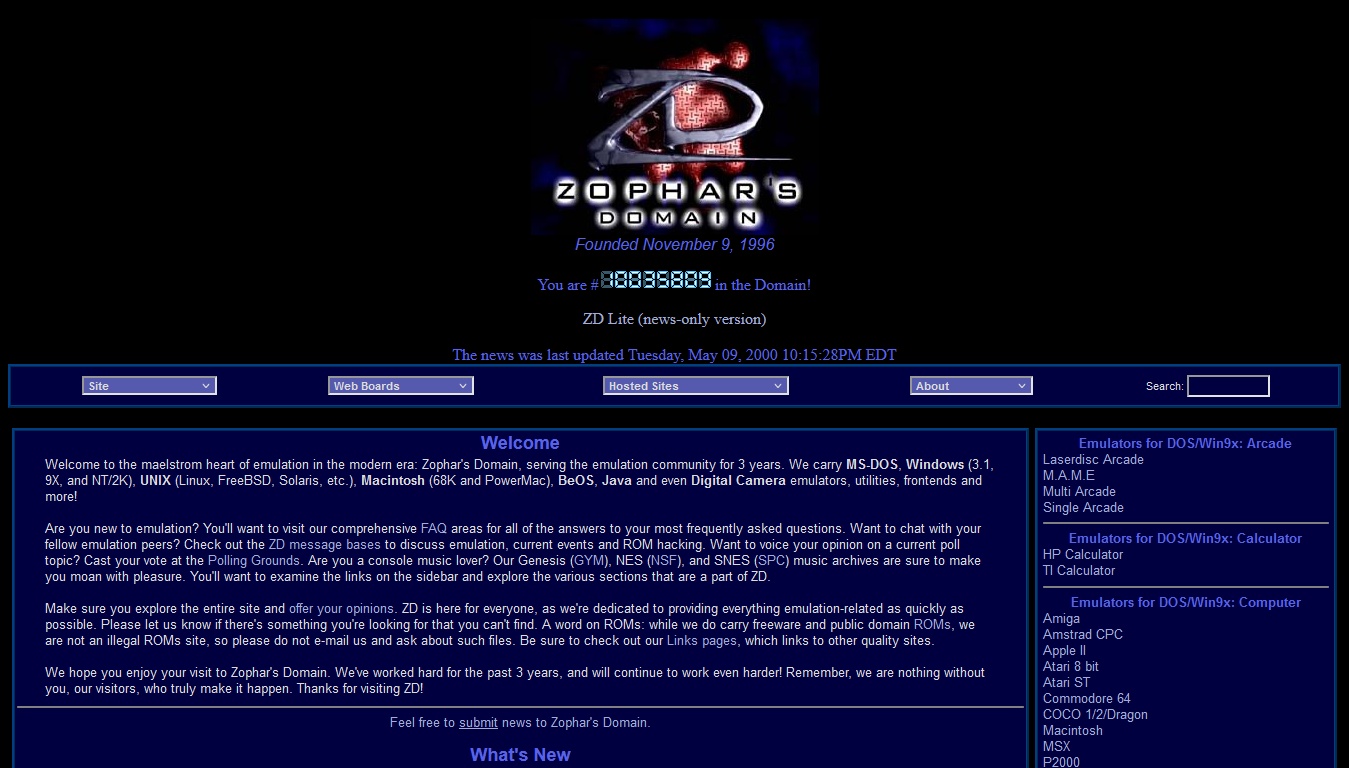
The news archives kept the arguments, too. Editors challenged authors, corrected one another, and sometimes apologized for a bad headline. Those exchanges let us follow a claim while it was still being disputed, before later reputations smoothed away the rough edges. A post could be wrong and still tell us what people announced, believed, or contested that day.
Where you looked depended partly on what you wanted to play. Someone following N64 developments might refresh Emulation64; an arcade fan might check MAME-focused pages and CPS2Shock; a Sega Master System specialist had SMS Power! in the bookmarks. Zophar’s Domain tried to cover nearly everything, gaining reach while making accuracy harder to maintain. Retrogames and its affiliated hosts offered another route to releases. That choice could shape a reader’s view of the scene. A project with an enthusiastic host might look like the future, while one with poor English, a broken mirror, or no news contact could go almost unseen.
Even a release date could be slippery. One site might post a file at midnight and another find it the next afternoon, leaving the earlier archive as the usual citation. But the author might already have shared it privately. A dated news notice establishes when the site announced a release; it does not necessarily establish when someone first downloaded it.

Brad Levicoff hands over Zophar’s Domain
In September, one of those familiar destinations changed hands. Brad “Zophar” Levicoff had founded Zophar’s Domain in 1996 and built it into one of the scene’s central archives. On September 20, 2000, he announced that Samuel Michaels would take over. The site’s own history page confirms the date and identifies Michaels as a staff member who had already worked on links and programming.

Sam Michaels Sam Michaels took stewardship of Zophar’s Domain in September 2000 after years of behind-the-scenes work on its links and code.
Levicoff described schoolwork slipping as the site took more of his time. At nineteen or twenty, he was running something thousands of people relied on, with the demands of a job and few of its boundaries. His farewell thanked emulator programmers, news writers, code helpers, webmasters, friends, and family—a community without a central office or payroll. Behind the site bearing his handle were people supplying releases, links, corrections, graphics, and encouragement. He asked readers to respect their unpaid hours, while trying to send everyone away with a sense of fun rather than the feeling that they had attended a funeral.
Taking over did not mean starting from scratch. The staff had been writing news, maintaining files, and building the site’s technical systems alongside its founder. Sam Michaels was already part of that work. The site’s later account traces his progress from links maintenance to CGI programming and, eventually, a PHP/MySQL era. That last stage came later; in September 2000, readers faced a more immediate question. Would the hub they depended on stay reliable after the person whose handle named it stepped away?

In his September 20 announcement, Levicoff connected the weather that night with his memory of launching Zophar’s Domain in November 1996. The handoff brought him back to the beginning. For visitors who had spent years checking the site every morning, it was a farewell from someone who had become part of their daily routine.
Some readers feared that Zophar had “quit” or that the site had been taken over against his wishes. Michaels posted a response insisting that Levicoff had passed the torch voluntarily, as Levicoff’s announcement and the site’s history also describe. Michaels promised faster news, a larger archive, cleaner descriptions, and a redesign. Readers wanted their downloads, but they also wanted accurate information, quick updates, and reassurance that someone was still looking after the place.
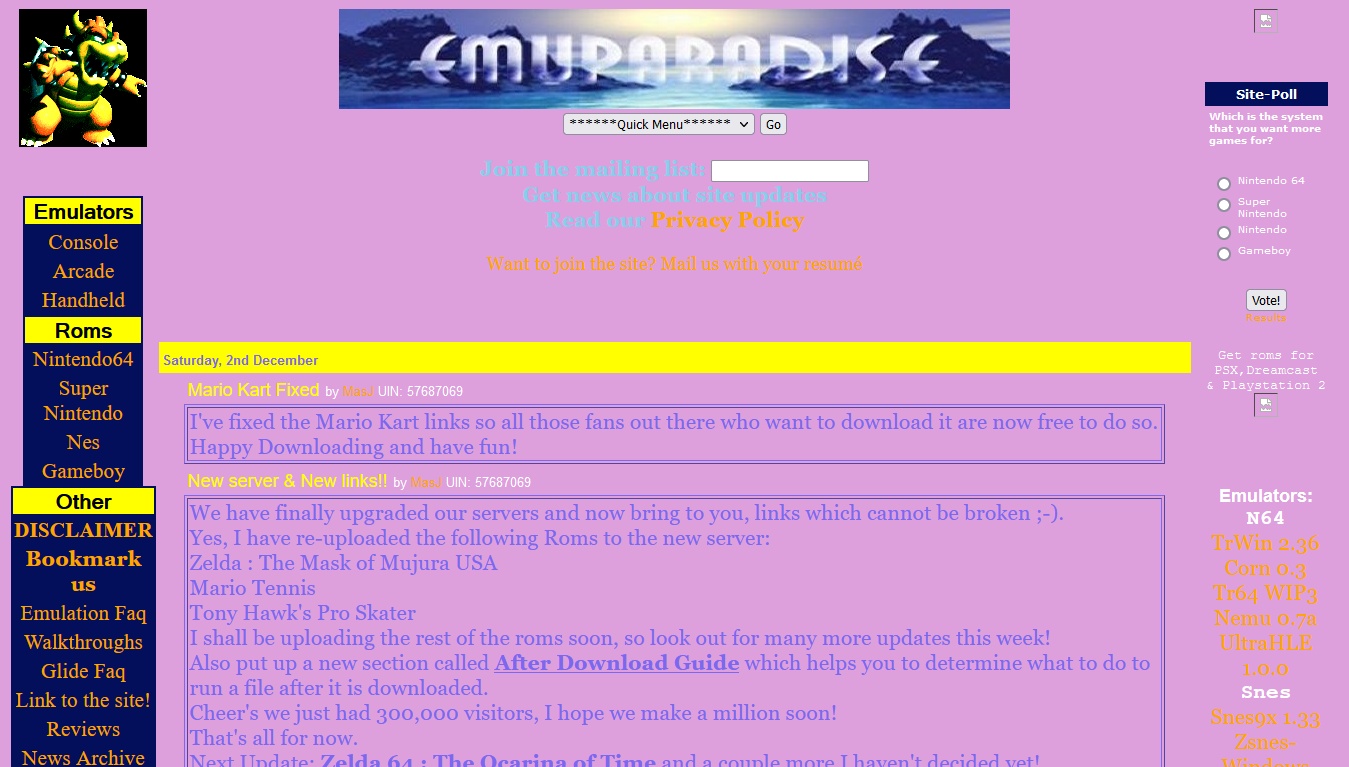
Just before the transition, Levicoff had updated his earlier “Emulation Dream” essay in the same September archive. People could approach emulation as code, sharing, piracy, or a way to learn, he wrote, but he urged them to remember the joy in it. After a year of public fights and relentless demands, he was asking readers to have fun while acknowledging that running the site had pulled him away from school. Keeping other people’s hobby going had left less room for his own life.
A newsroom with arguments inside it
The handoff was not the first sign of strain at Zophar’s Domain. A September 2 post recorded a departing contributor’s account of a dispute over writing for other emulation sites.

The workload had been piling up for months. In his April return announcement, Levicoff acknowledged criticism, thousands of unanswered email messages, problems with translation coverage, and dead links. He promised to improve the site page by page and brought the controversial editor InVerse back into the mix. The announcement was combative and funny. The work waiting behind it was less entertaining: an enormous inbox and page after page that needed attention.
A dead link could cost visitors more than a wasted click. An emulator developer might release a build on a personal home page, then lose that page when a university account ended. Unless a news site copied the file in time, readers could be left with an announcement for a program they could no longer download. Translation patches were especially vulnerable when the small groups hosting them reorganized or disbanded. Cleaning up the links meant tracking down the files, not just making the pages look tidier.
Unpaid work also came with competing expectations. A volunteer writing for two sites might see it as helping the same community twice; an editor might worry about losing exclusive news or staff loyalty to a rival. The September contributor’s own post shows where those expectations collided. Enthusiasm could supply a newsroom with writers, but it did not settle who could ask what of them.

Michaels was taking over an archive that needed constant tending. A host could close and take a download with it. A ROM hack group could change its address and leave a guide pointing nowhere. If a contributor quit, an entire section might go stale. Levicoff’s departure did not have to end the site, but keeping it useful would take people willing to keep chasing those changes.
EmuParadise opens in March
While established sites wrestled with that workload, another had opened its doors. MasJ’s own staff profile dates the start of Emulation Paradise, as the project was originally called, to March 27, 2000. A preserved early version of the site contains November 2000 updates and credits MasJ for the design. Together, those records give its first year a firmer date than the vague “around 2000” found in later retrospectives. The site that would grow into EmuParadise was starting out among plenty of busy neighbors.
MasJ MasJ founded Emulation Paradise on March 27, 2000, then built the early site that would become EmuParadise.
By November, Emulation Paradise was counting games and fixing broken links. One update put its Nintendo 64 collection at seventy entries, then admitted that not every link was available. Other posts tracked additions and repairs. The team was building a larger collection while trying to keep the existing one within reach—a familiar problem for anyone who had finally found a game file, clicked its link, and got nowhere.
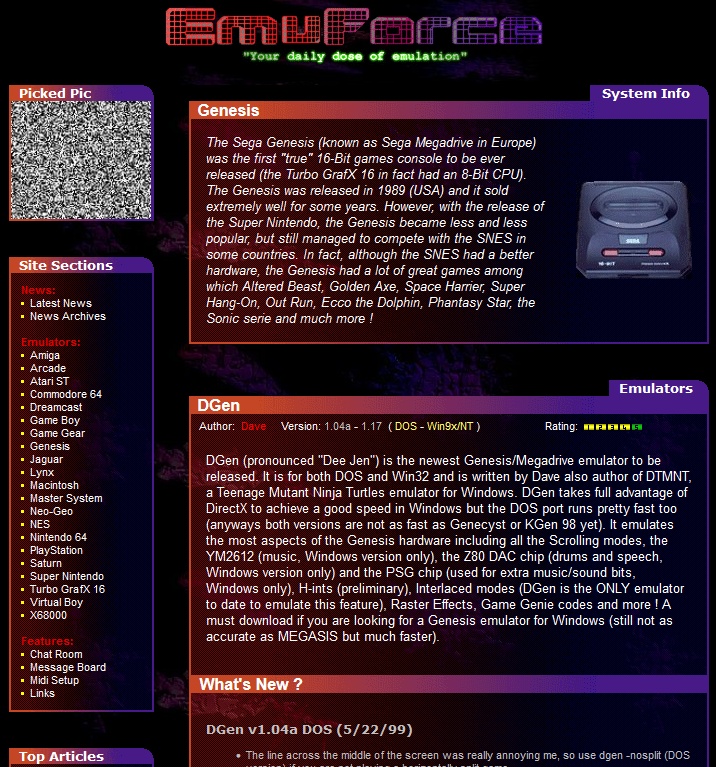
The surviving page lets us see the early portal’s layout, navigation, small dated updates, and disclaimer. It is a restored early design containing November 2000 entries, rather than an untouched browser capture from launch day. Even the restoration warns that some old links may no longer work.
“Emulation Paradise” promised abundance, but finding a file was only part of getting a game running. A newcomer still had to choose an emulator for the right system, check that the game image was complete, and configure sound and controls. Multiple categories and regular updates offered some relief from that confusion and helped the site find an audience. Game-file distribution also brought legal scrutiny, and the site later became deeply controversial over its downloads.
MasJ appears in the surviving records under his handle. They reveal little about his private life, but the dated updates, early design, and repair notices trace his work turning a fragile collection of links into a destination.
EmuForce and the hosting economy
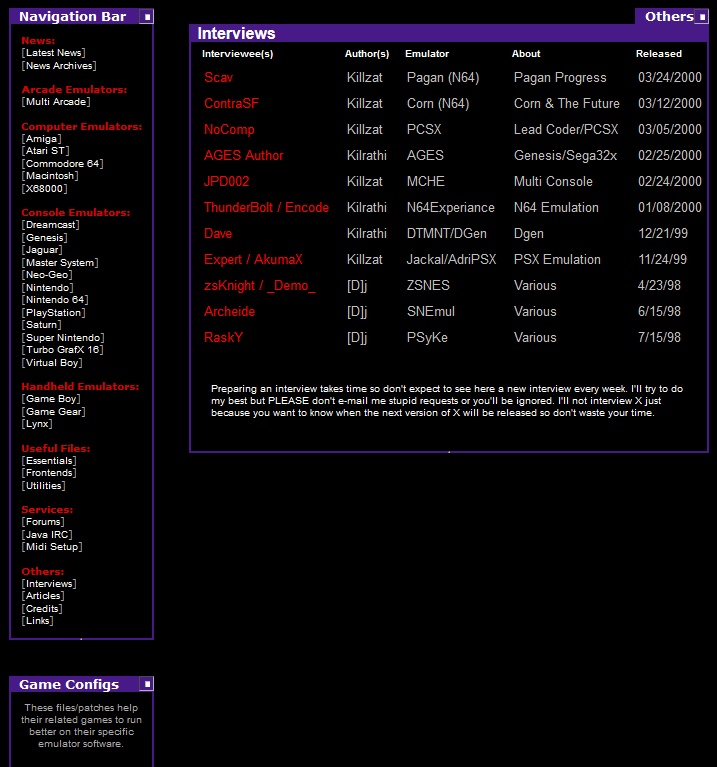
An emulator also needed somewhere to live. The local site-history archive identifies EmuForce as a host and promoter for FPse, PCSX, and Gens in 2000. Contemporary news pages link to FPse and PCSX addresses on EmuForce, confirming that those two projects used the network during the period. Hosting supplied space, bandwidth, and an address; it did not necessarily mean writing the emulator or speaking for its author.
When a host disappeared, a project could lose its download, news archive, and contact page together. A mirror might rescue the program while leaving its history behind. The November ePSXe traffic notice shows a less lasting version of the problem: a popular launch could temporarily overwhelm a site. For a smaller project, an unexpected bill or a change in hosting policy could erase its public trail. Networks such as Retrogames, EmuUnlim, and EmuHQ gave authors more ways to stay reachable.

A webmaster could do more than keep a server running. They might introduce an author to an interviewer, put a new build on the front page, or explain that a release was only a test. That attention could bring collaborators to an obscure project. It could also start arguments over credit, exclusivity, and who posted the news first. Those disputes reached beyond the news pages, shaping who downloaded an emulator and who chose to keep working on it.
Several familiar people were still providing those routes into the scene. Stephen Richards had built EmuUnlim into a major host and news presence. Tim Eckel was behind Arcade At Home, a recognizable home for arcade emulation. Dave (Conjuror) had expanded Dave’s Video Game Classics into the Vintage Gaming Network. A new author could arrive through one of these established networks and reach readers across the others.
At Retrogames and other hubs, a project could use a subdomain of the larger site while keeping its own design and its author’s voice. The host gained an active collection of projects; the author gained a stable address and an audience. A dispute could still break that arrangement and send the project’s public home elsewhere overnight. The names look permanent in hindsight, but the 2000 archives show addresses moving beneath them.

An emulator release could appear on hundreds of personal pages and still depend on one server. Those pages often linked to the same zip file; when the server buckled, a reader got an error and might assume the project had vanished. Hosting meant supplying the bandwidth to keep that download available. Mirrors spread the load and sometimes kept older versions after the official page replaced them. They could also keep serving a buggy build after its author had fixed it. Versions and dates needed clear labels, or the search for a working emulator could end with yesterday’s problem.
Contemporary posts gave FPse and PCSX EmuForce-hosted URLs, directing users there for official news. Those addresses connected the authors, their projects, and the host that made their work public. Later redirects and domain changes made some original paths hard to reconstruct. A modern home page could keep an emulator reachable while leaving little trace of where players first followed its progress.
Emulation64, specialist news, and the value of a focus
N64 followers could turn to Emulation64’s preserved May 2000 archive for the first Apollo build and other project news. Its readers wanted to know about CPU cores and compatibility lists—the machinery being emulated and the games it could actually run. A broad portal might give a new N64 emulator one line. A specialist could keep the version number, link to the author, and compare competing projects. It could also save readers from downloading a debugger release and expecting an evening of games.

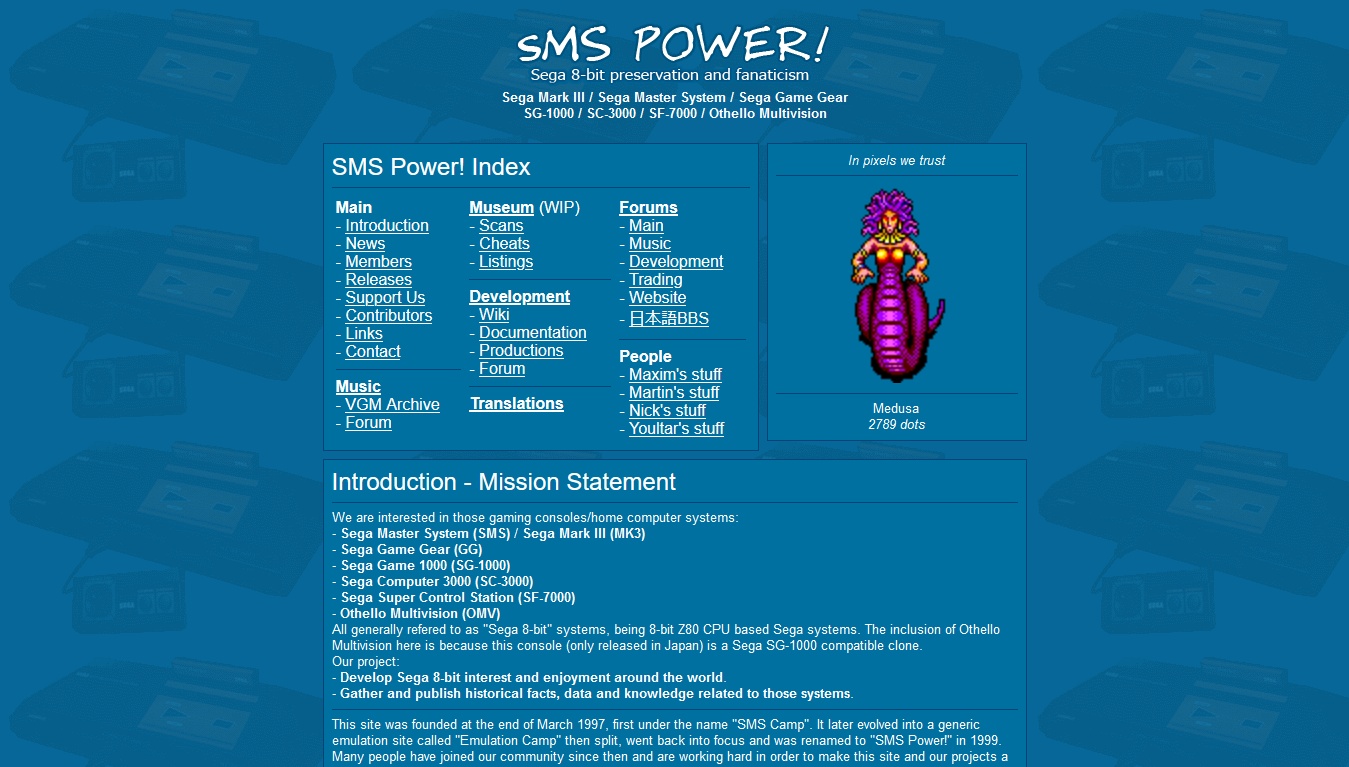
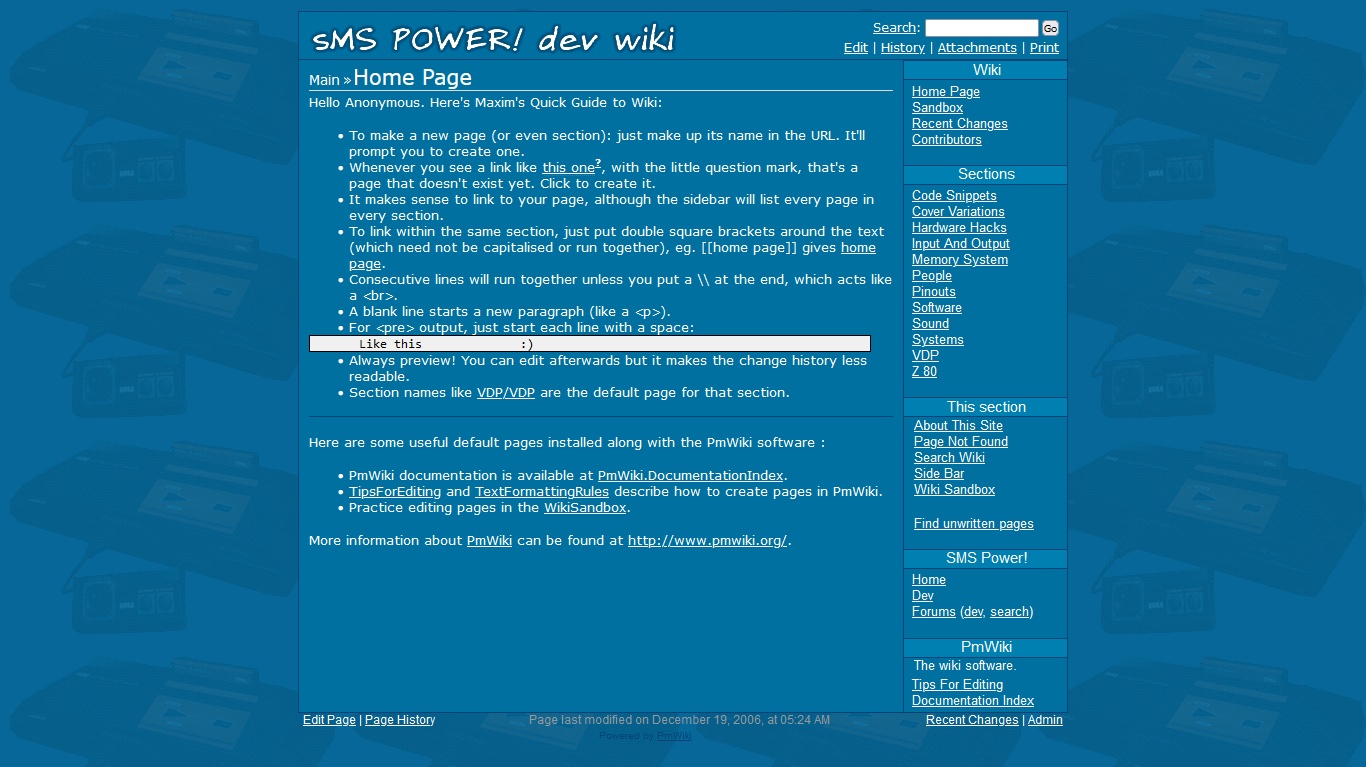
SMS Power! gave the Sega 8-bit community a similar focus, while CPS2Shock helped organize technical research around Capcom’s protected arcade boards. These specialist sites gave experts somewhere to share dumps, checksums, documentation, and corrections. A useful contribution did not have to be today’s biggest headline. It might be the careful note someone needed months later.
A single entry in a portal’s system list could hide a great deal of work. The Master System had cartridge mappers, regional software, and hardware quirks to account for. CPS-2 had encrypted program data and protected boards. N64 developers were caught in a sprawling argument over graphics microcode and compatibility. People who knew those systems could explain their problems more usefully than a general editor rushing through fifty updates. The specialist pages supplied that depth, and the large portals carried it to a wider audience.
Interviews opened another route into the work. An author explaining why a game would not run could teach other coders far more than a one-line “new beta” post. Site operators who asked good questions brought private reverse engineering into the shared technical record. Programmers using pseudonyms could discuss their work without giving away every detail of their private lives. Their handles became part of the scene’s history, whether or not a legal name was available or relevant.

The explanations could disappear even when the downloads survived. A captured home page might survive while its linked FAQ disappeared; a mirrored program might lose its readme along the way. The best 2000 sites linked generously to work elsewhere, but those links could later go dead. Reconstructing a release now can mean finding the file in one place and the explanation of what it did in another, then tracing both back to surviving evidence.
MAMEWorld, Logiqx, and the archivists around the archive
A preserved site-history account places MAMEWorld and Logiqx among the projects emerging around 2000, though the surviving material does not establish a precise launch day for either. Their later roles are clearer: MAMEWorld became a hub for MAME users and hosted projects, while Logiqx supplied data files and change information useful to arcade emulation.
MAME’s growth gave sites like these plenty to do. With hundreds of boards and thousands of game variants supported, users had to work out what had changed, which files belonged to which game set, and which frontend—the program used to browse and launch games—matched the current emulator core. A dedicated news hub, a data-file maintainer, and a forum helped people find their way through that expanding arcade library.
Even a working emulator could appear broken if a game set’s names did not match what its driver expected. A checksum list could reveal that a file was incomplete. A release tracker could tell a player whether the latest beta contained a fix or whether the promising note they had found referred to an older release. As emulators grew, memory and word of mouth could no longer keep all those details straight. The 2000 web gained tools and sites devoted to sorting them out.
An official MAME beta could set several other sites scrambling. Ports and frontends had to catch up; game-list maintainers updated names and checksums; news writers turned the change log into something readers could scan. If one layer fell behind, players felt it. A frontend using the previous list might omit new games. A mirror serving an older binary might make a newly fixed driver seem broken. MAMEWorld could help without writing a line of emulation code: it told readers which moving pieces belonged together.
Brazil, France, and a scene larger than English
For someone who could download an emulator but could not read its instructions, language was another obstacle. The offline site-history archive describes Brazilian sites such as Emulação Online and Emulando expanding their forums, translations, utilities, and coverage around 2000, without establishing exact launch or redesign dates. These sites gave readers explanations and communities in their own language—a considerable help when automatic translation was far rougher and slower than it is now.
French communities built news, translation, and hosting networks of their own. A history drawn only from Zophar or Retrogames would miss much of that activity. A game patch might first be discussed in Portuguese, a hardware document translated into French, or a Japanese SSF readme brought to English readers by a fan translator. Information crossed borders because someone took the time to read it, translate it, and pass it on.
The September SSF readme translation shows that work in practice. The Japanese emulator was publicly available, but many Western fans still needed help understanding what it ran and what hardware it required. Translating those details gave readers a way to judge the release without either dismissing it or expecting more than it could deliver. The translator helped make the emulator usable news.

Language also affected which releases reached later English-language histories. A Japanese update might attract attention only after a screenshot reached an English forum. A Brazilian patch group’s translation could be familiar locally and barely mentioned by a US portal. Comparing the old site-history archive with contemporary pages exposes some of those gaps: the surviving English web records only part of the scene.
News sites, ROM sites, and the line that never stayed still
Finding an emulator and finding games for it often led readers through the same portals. Many sites in 2000 mixed emulator files, public-domain demos, translation patches, technical articles, and links to copyrighted games. Their operators differed over both the law and the ethics. Some developers wanted their emulators widely distributed but kept their distance from unauthorized game downloads. A portal could call itself a news service while readers used it as a route to ROMs. Levicoff’s September essay shows people inside the scene arguing over those overlapping roles.
EmuParadise’s preserved 2000 pages show a young site posting game-file updates alongside disclaimers. Zophar’s archives contain emulator releases and debates about pirated material. Specialist sites could concentrate on documentation while still linking to risky resources elsewhere. Even within one site, the people involved did not necessarily agree: an emulator author might not approve a host’s ROM links, and a news writer did not automatically speak for the whole staff. Nor did a website designer’s angry post establish that an emulator team had stolen code. The pages preserve what people posted and argued about, not a single shared position.
When a volunteer newsroom loses a voice
On September 2, Bender posted a departure notice in Zophar’s surviving news archive. In his account, he had been asked to stop writing for other emulation sites or leave Zophar’s Domain. He chose to leave. The short post also described his love of emulation and his wish to share it wherever he could. Zophar kept the notice online, leaving a public trace of a staff conflict that might otherwise have stayed in private email.

On September 29, a later archive entry brought a returning contributor, Lycia, back into view. Lycia described Zophar’s staff as an online family and thanked both Brad and Sam. The handover had not settled every relationship overnight. People left, returned, argued, and promised better coverage. Meanwhile, emulator releases kept arriving, and somebody still had to post the news.
That work had a daily rhythm: find a release, check its claims, write a notice, repair the download when readers complained, then do it again tomorrow. The September archive is almost exhausting to scroll. Keeping up with that volume gave volunteers something to be proud of. It also helps explain the friction over where they spent their time and who got to publish their work.
The human cost of keeping the lights on
By late 2000, these websites offered far more than release notices. Readers could find biographies, FAQs, interviews, message boards, utility lists, game-music players, translation patches, and archives of old posts. Each addition brought more work behind the page: email, broken links, hosting problems, reader complaints, and the expectation that updates would arrive immediately. Brad Levicoff had schoolwork to manage. Sam Michaels had promised to rebuild descriptions. MasJ was repairing links in November. Running a site meant finding time for all the jobs that never appeared in an emulator’s feature list.
The old web had handmade pages and excited fans. It also had administration. Someone had to pay for storage or persuade another person to donate it, stay up to replace a corrupted zip, or correct a notice after a game described as “playable” crashed at the title screen. A vacation could end with thousands of messages waiting. Much of the software in the first three chapters might have existed without this work, but far fewer players would have found it, and fewer records of it would survive today.
Zophar’s Domain continued under Michaels. EmuParadise was only beginning, specialist projects kept building their archives, and emulator authors kept sending new releases into the network. The sites competed, and their arguments sometimes drove people away. They also gave a programmer’s small experiment a route to players who could try it and share the discovery.
Some of those discoveries left much fuller records than others. A famous release collected mirrors, interviews, and screenshots; a quiet compatibility fix might appear once in a monthly archive and nowhere else. The person who wrote the code could have a long biography while the person who translated the readme remained a handle in a thank-you line. People were trying things before they knew which efforts would last. What survives includes the excited announcement, the corrected link, the argument that cooled down, and the next morning’s post.
A 2000 game in the GameBase
Perfect Dark’s Game Boy Color edition in Retro Replay GameBase is listed as a 2000 release. Rare’s spy thriller had a separate life on Nintendo’s little handheld. While the websites looked back at older machines, the Game Boy Color was still giving their readers new games to talk about.

People in this chapter
- Brad “Zophar” Levicoff — founder who handed Zophar’s Domain to Sam Michaels on September 20.
- Sam Michaels — longtime Zophar staff member who assumed leadership.
- MasJ — founder of Emulation Paradise on March 27.
- Stephen Richards — EmuUnlim founder and returning web-scene figure.
- Tim Eckel — Arcade At Home owner and returning figure.
- Dave (Conjuror) — Vintage Gaming Network figure and returning site host.
Sources and further reading
- Zophar’s Domain site history.
- Zophar April 2000 archive: return, backlog, and redesign plans.
- Zophar September 2000 archive: contributor departure, Levicoff handoff, Michaels response.
- MasJ’s own staff profile, with March 27 start date.
- Preserved early Emulation Paradise site with November 2000 updates.
- Emulation64 May 2000 archive.
Part of: The Complete History of Video Game Emulation
Browse biographies: People in the History of Video Game Emulation