 Retro Replay Retro Gaming History, Reviews & Emulation

Brad Levicoff was a fan discovering emulation before he was the founder of one of its best-known archives. In his later account, a friend introduced him to the subject in the summer of 1996. Virtual GameBoy caught his attention; pages such as Node 99 and Archaic Ruins showed him where to look next; local bulletin boards supplied old builds to try. Within a few months, he had created a site of his own. Zophar’s Domain went online on November 9, 1996, with a front page, a What’s New page, and links. That spare beginning is easy to forget when looking at the large emulator archive it became. Levicoff’s real contribution was the habit of returning, updating, and giving readers a reason to return too.
Name and handle: Brad Levicoff, known online as Zophar
Known for: Founding Zophar’s Domain
Launch: November 9, 1996, according to the site’s own history
First version: Front page, What’s New page, and links
1996 controversy: Levicoff later recalled a failed December 14 protest over VSMC’s restricted free build
Later milestones: Handed site management to Sam Michaels in 2000; returned to the staff in 2008
Historical caution: Detailed 1996 recollections quoted here were published in November 1998, not captured on the day they describe.
From Local BBS to a Web Identity
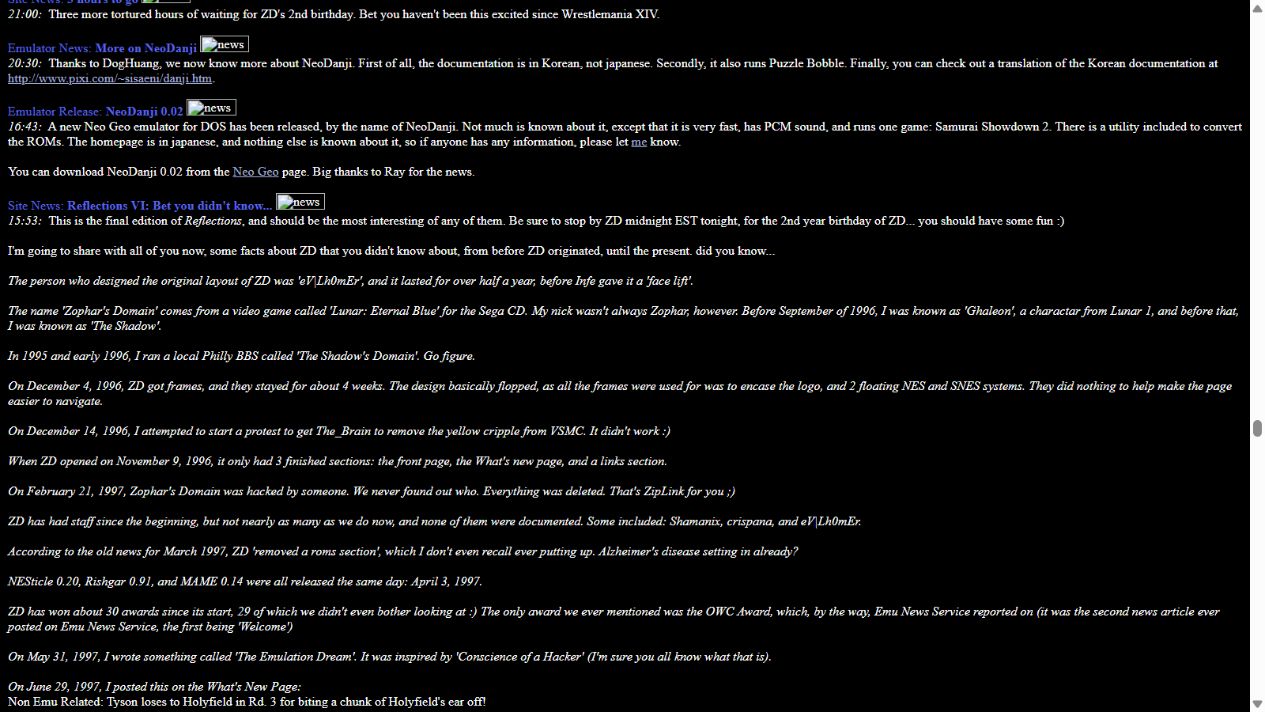
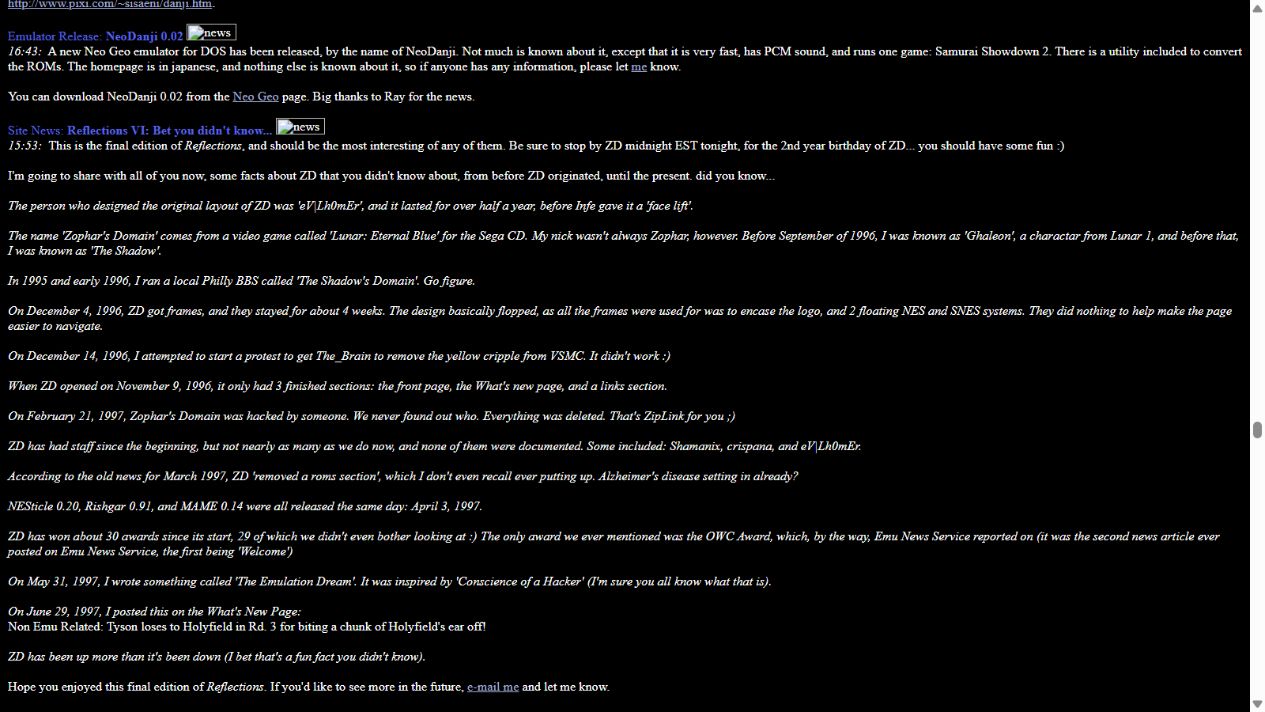
Levicoff’s 1998 anniversary reflections take readers back before Zophar’s Domain existed. He remembers running a local Philadelphia bulletin board called The Shadow’s Domain in 1995 and early 1996. That matters because it places his later website inside an older culture of dial-in communities, handles, and file exchange. The web did not erase those habits in one year. Early emulation readers might discover a build on a BBS, hear a recommendation on IRC, and finally find a current version on someone’s homepage.
He also tells the story of his name. Before September 1996, he had used other handles; he chose Zophar after a character from Lunar: Eternal Blue. That is why the site is called Zophar’s Domain rather than Brad’s Emulator List. In a scene where programmers and editors frequently worked under handles, the nickname became the public identity. A reader could recognize “Zophar” without knowing Levicoff’s legal name. A biography should hold those identities together rather than invent two separate figures.
His route into emulation was social. A friend showed him the possibility, early sites gave him examples, and the programs themselves gave him something to talk about. He did not need to write a CPU emulator to become useful. He needed curiosity, a willingness to organize information, and enough persistence to keep updating when releases and links moved. That editorial role would become increasingly important as the number of programs grew.
November 9, 1996: Zophar’s Domain Opens
There was a short Geocities experiment around October 1996, but Levicoff says that site was not yet the emulation-focused Zophar’s Domain. He remembered severe space limits and an address that was hard to share. The later archive began on a personal ZipLink path. The site’s own About page confirms November 9, 1996 as the official launch date, and Levicoff’s 1998 reflections describe what was actually ready: a front page, a What’s New page, and a links section.
Those three sections reveal an editorial strategy. The front page established identity. The news page made a visit worthwhile even if the visitor had been there yesterday. The links page connected readers to developers and other archives. The site did not need to store every file at the beginning to become part of the network. A reliable link to an author’s current release could save a fan from an outdated mirror. A short update could alert dozens of people that a new build existed.
Levicoff kept experimenting with layout. He later dated a frames design to December 4, 1996 and said it lasted about four weeks. He judged it a failed change because the frames offered little benefit. The detail is small but wonderfully revealing: the famous archive was still a young person testing presentation choices on a live site. It had not arrived with the settled navigation and deep file categories that later readers associate with the name.
Keeping Score of Old Programs
In November 1998, Levicoff marked the site’s second anniversary with a series of reflections. One installment gathered old emulators he remembered from BBSs and pages such as Node 99 and Archaic Ruins. It listed release versions and his impressions of programs including Snes96, Super Pasofami, and VSMC. The collection was both nostalgia and preservation. Two years was already enough time for a 1996 emulator build to feel ancient in this fast-moving field.
His Snes96 memory captures the period’s standard of success. A version could feel exciting if it played games at something approaching tolerable speed on a sufficiently fast machine. That does not mean broad compatibility or faithful sound. It means a technical barrier had visibly shifted. A useful archive had to retain that context; otherwise a later reader might see an old filename and judge it only against modern emulators. Levicoff’s version list preserved a sense of what each release meant to users at the time.
Preservation also required editorial judgment. A warning about a risky program could help a reader; an inaccurate accusation could unfairly shadow an author. Levicoff’s retrospective included an allegation about a Super Pasofami version damaging Windows files. Archaic Ruins later carried a related warning. The exact behavior has not been independently reconstructed for this biography, so it remains an attributed report. The point for Levicoff’s story is that an archive was never merely storage. The person maintaining it decided which files to host, what to say about them, and how to express uncertainty.
The VSMC Dispute
Levicoff also remembered a December 1996 controversy around Virtual Super Magicom, the SNES emulator made by Chris George, known as The Brain. In his 1998 collection he labeled a December 8, 1996 build as the last free version before the unpaid copy received a yellow visual restriction. On December 14, he says, he tried to start a protest asking George to remove that restriction. He says it did not work. Those are his own later recollections; we have not found the original protest page.
The disagreement had more than one understandable emotion behind it. Emulator authors invested enormous time in difficult, poorly documented hardware, and George’s wish to earn money from VSMC should not be erased. Users who had followed a program while it was free could nevertheless feel that a deliberately unpleasant free build broke an expectation they had helped create. Levicoff chose to use his young platform to speak for the dissatisfied readers. The failed protest is one of the earliest clear examples in his record of an emulation news site becoming a participant in scene politics rather than a neutral noticeboard.
Later accounts of VSMC became harsher and mixed in 1997 and 1998 events. This biography keeps the 1996 claim narrow. Levicoff attempted a protest over the color restriction, and by his own account it failed. That is enough to show his willingness to take a side. It also shows the limits of an archive owner’s influence: a visible site could mobilize criticism, but the software author still controlled the release.
From Personal Page to Institution
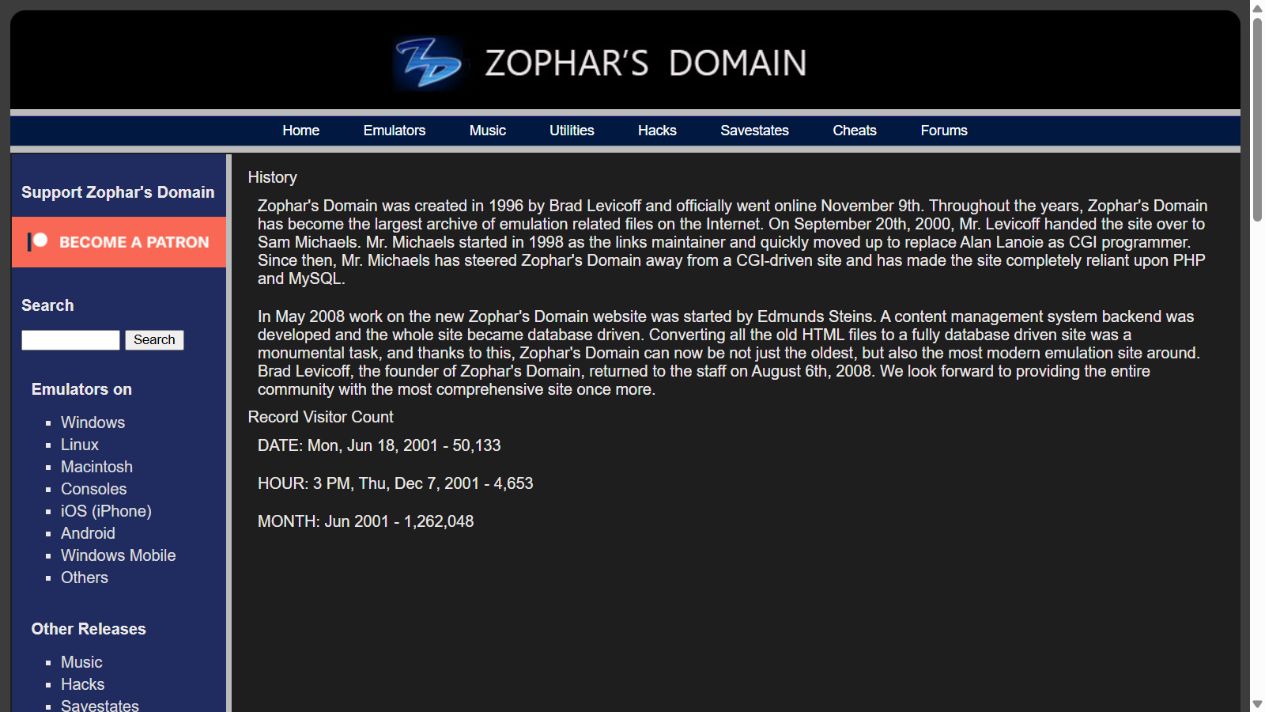
The site kept growing after 1996. Its current history page says Levicoff handed Zophar’s Domain to Sam Michaels on September 20, 2000. It also records his return to the staff in August 2008. Those later dates are important because they show the archive outliving the period when its founder personally did every update. A site that begins as one person’s homepage can eventually become an institution with maintainers, changing software, and a history worth recording.
The About page describes transitions in the site’s technical foundation, from earlier CGI-driven pages to PHP and a database-backed archive. The precise implementation is a later chapter, but the underlying problem was present at launch: once there are enough emulators, platforms, versions, and files, a hand-maintained list becomes difficult to keep orderly. Levicoff’s three-page start was possible because the archive was small. Its eventual architecture had to accommodate the scale its updates helped create.
His anniversary writings are especially valuable today because they remember embarrassing or ordinary details that official histories often drop: the forgotten Geocities URL, the frames experiment that flopped, the very small first site, and the protest that went nowhere. They make the founder recognizable as a person learning in public. They are also retrospective. The dates and claims should be read alongside surviving site artifacts, not treated as automatically equivalent to a complete 1996 news archive.
Why Brad Levicoff Matters
Brad Levicoff matters because Zophar’s Domain gave emulation a durable place to be seen. It carried news, links, and files across platforms and generations while the projects themselves moved or disappeared. A programmer could release a build; Levicoff and later staff helped readers find it. His site also became a record of how quickly the field changed. When he revisited old binaries in 1998, he was already preserving an era that had nearly vanished from ordinary browsing.
His story illustrates the power and discomfort of running a scene hub. A site’s owner can amplify a release, warn about a risky file, criticize a pricing decision, and shape what later readers remember. Those choices deserve scrutiny as well as appreciation. Levicoff’s best evidence for his beginning is his own candid memory of a tiny site built by a newly excited fan. The large archive came later, one update at a time.
Brad Levicoff in the History of Video Game Emulation
1996 Part II: The Websites That Held Emulation Together introduces Zophar’s Domain at its November launch and follows the December VSMC dispute. Later chapters can trace the site’s 1997–2000 growth without moving those developments backward into 1996.
Related People
Chris Hickman — Archaic Ruins founder, whose site Levicoff remembered visiting in 1996.
Martin Nielsen — NES WORLD editor and another early curator of emulator links.
Chris George — VSMC author at the center of the December 1996 pricing dispute.