 Retro Replay Retro Gaming History, Reviews & Emulation

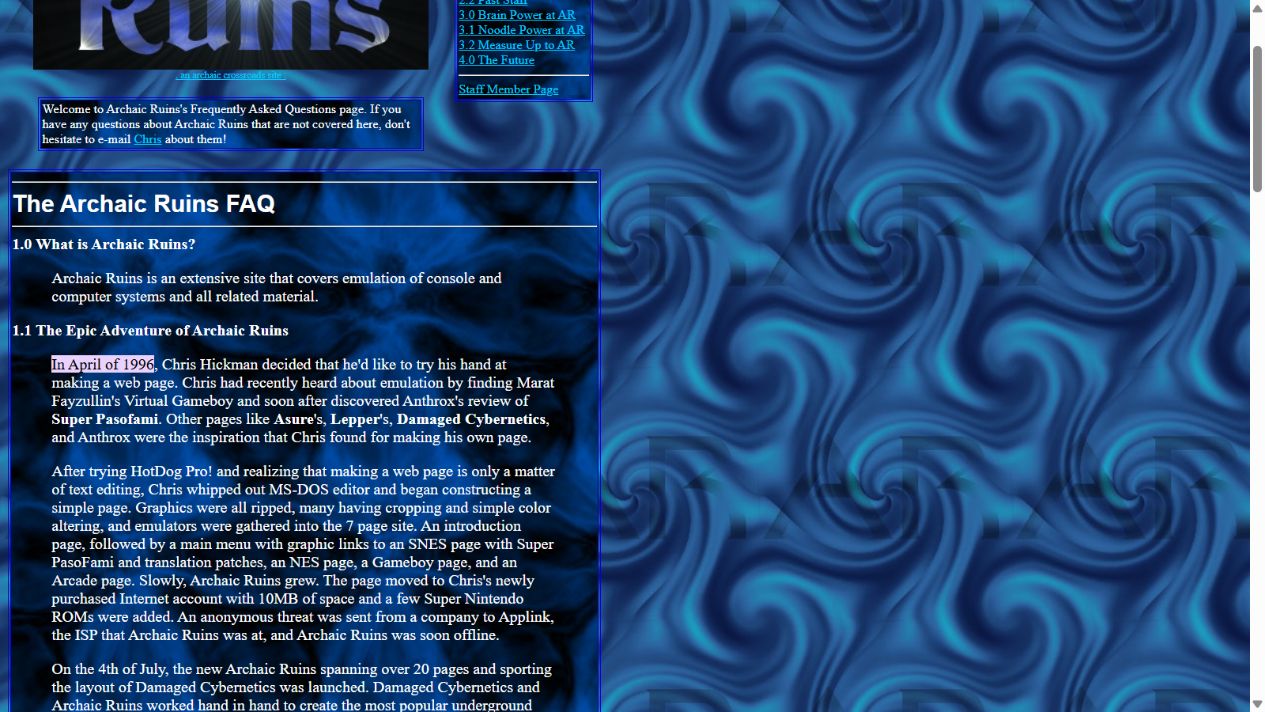
Chris Hickman did not begin Archaic Ruins with a grand plan to become one of the early emulation web’s archivists. In his own account, he found Marat Fayzullin’s Virtual GameBoy, read an Anthrox review of Super Pasofami, looked at the small collection of fan pages already appearing around emulation, and decided to make a page of his own. He tried a web editor, discovered he could do the important work as text, and opened the MS-DOS editor. In April 1996, that decision produced a seven-page site. Before the year ended, Archaic Ruins had gone offline under pressure, returned with more than twenty pages, and become part of a larger network. Hickman’s achievement was not an emulator of his own. It was building a place where other people’s emulators could be found, compared, discussed, and remembered.
Known for: Founder and original designer of Archaic Ruins
First site: A seven-page emulation guide assembled in April 1996
1996 turning point: Rebuilt the site after an anonymous threat to its Internet provider; relaunched July 4
Wider role: Curated emulator links, utilities, articles, and later preservation material
Historical caution: The original threat and first seven-page design have not been located; their sequence comes from Hickman’s later first-person FAQ.
Finding a Scene Worth Mapping
By spring 1996, console emulation was easier to hear about than to understand. Programs were scattered across personal pages, FTP spaces, bulletin boards, and links passed between enthusiasts. Some were impressive demonstrations with little practical compatibility; others required a particular operating system or an image conversion step. Hickman was a user facing those same obstacles. His discovery of Virtual GameBoy and the Super Pasofami review gave him a reason to look for more. Sites such as Anthrox and Damaged Cybernetics showed him that a web page could make the subject less opaque.
The seven-page Archaic Ruins reflected a broad curiosity from the start. Hickman recalls an introduction and main menu leading to pages about the SNES, NES, Game Boy, and arcade emulation. That mixture is important. The site was not built around one developer’s release schedule or one machine’s fans. It put neighboring experiments next to one another. A reader who arrived for a Nintendo program could find an arcade project in the same sitting. At a time when there was no dependable central catalog, the menu itself was a useful piece of editorial work.
Hickman was unusually frank later about the rough construction. He says some early graphics were copied and altered. That detail is not a license to romanticize copying; it is part of the record of how quickly a hobbyist page could be assembled in the young web. The priority was getting information online. A few images, a menu, and working links were enough to help readers navigate a rapidly changing subject. His account lets us see the beginning without pretending the first site was already the polished archive that followed.
The Host Disappears From Under the Site
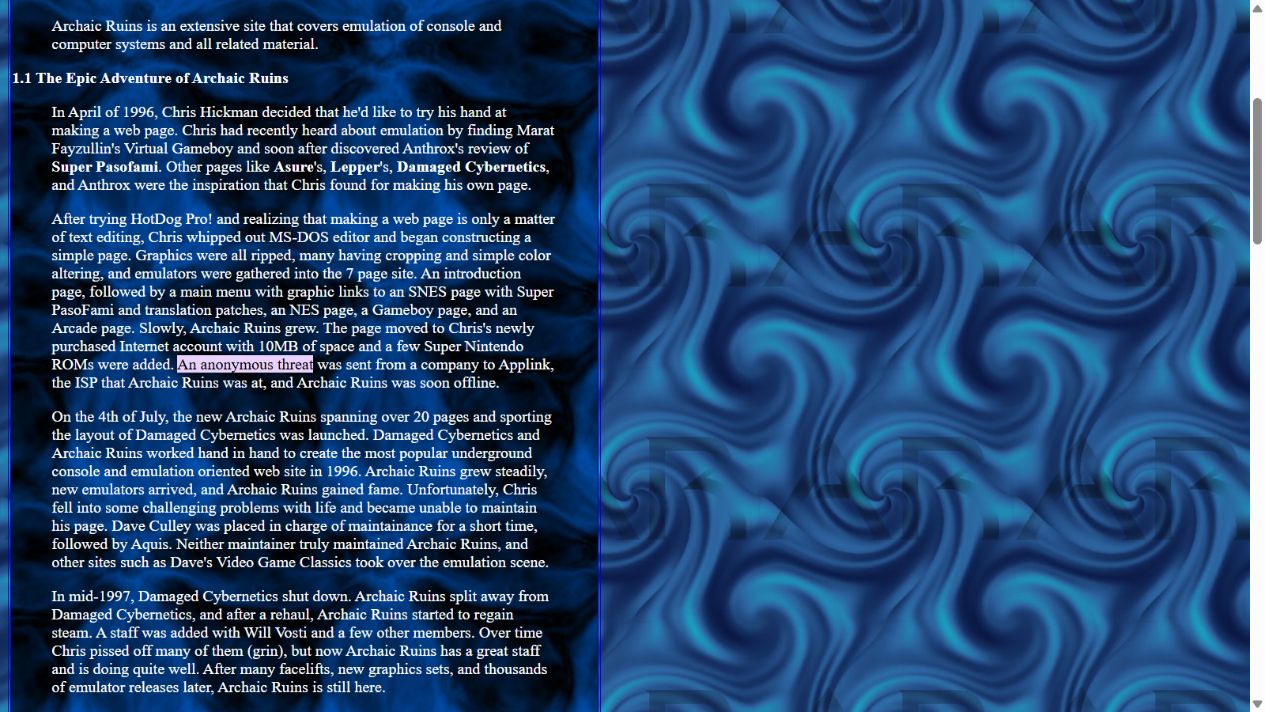
Archaic Ruins expanded onto a paid Internet account and began hosting more material, including a few Super Nintendo ROM images. Hickman says an anonymous company sent a threat to Applink, the provider hosting the site, and Archaic Ruins soon went offline. His FAQ does not preserve the letter or identify the company. We cannot assert the exact claim it made, or whether it targeted the emulator files, the game data, or the site as a whole. What the first-person account establishes is the practical outcome: a growing fan resource lost its home.
For a site owner in 1996, that could undo months of small acts of maintenance. Each link pointing to the old address became another dead end. Visitors could assume the project was finished. A file mirrored elsewhere might still exist, but the notes that explained which version it was or how to use it could be harder to recover. Hickman’s biography therefore includes an unglamorous but central emulation task: finding space, keeping files reachable, and rebuilding trust when a host could no longer carry the page.
He did rebuild. On July 4, 1996, according to the FAQ, Archaic Ruins returned with more than twenty pages and a Damaged Cybernetics layout. The comeback enlarged the site rather than merely restoring it. Hickman’s account describes the two sites working closely together during the rest of 1996. That connection offered recognition and cross-links in a world where a reader often found a new emulator page because another enthusiast pointed to it. It also meant the site’s visual identity was bound, for a time, to a broader network.
What an Archive Had to Do
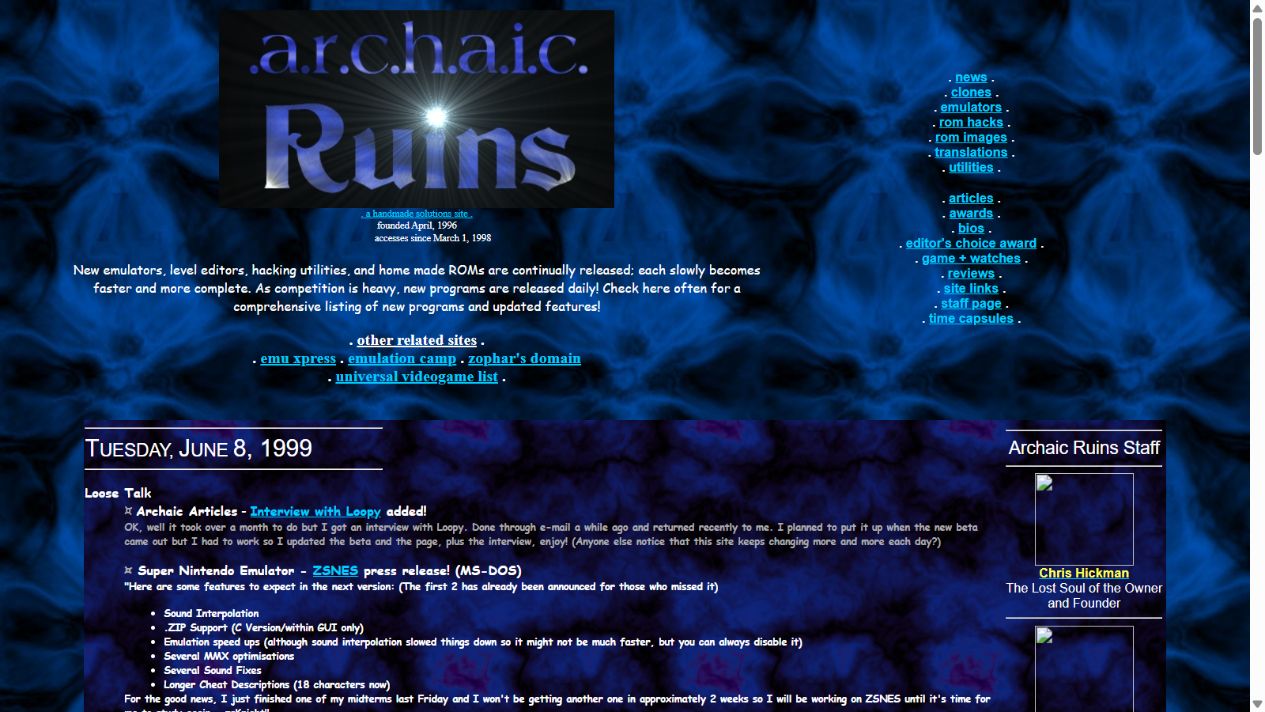
A directory of emulator files looks simple until the releases begin changing. The curator has to distinguish a new build from an older one, name the host platform correctly, explain missing features, and decide whether a warning needs to be attached. Archaic Ruins’s preserved later pages show how involved that work became. Its SNES directory lists authors, download files, dates, support routes, and candid comments on performance or limitations. Some preserved listings were revised in 1997, so they cannot be treated as an exact image of the July 1996 site. They do show the method Hickman’s small project developed.
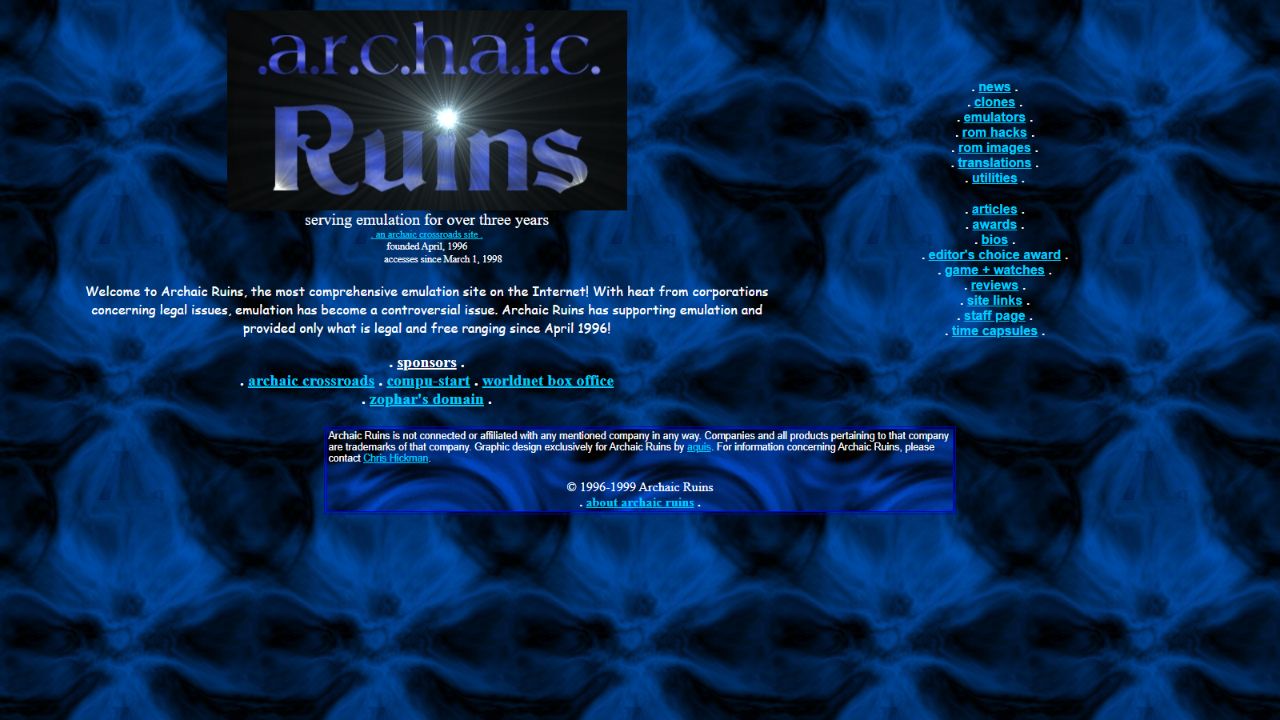
The scope widened beyond executables. The later site carried news, utilities, translation material, articles, reviews, and links to other people. That mattered because the file by itself often answered very little. A player might need a converter, a compatible image format, a fast enough computer, or an explanation for why a screenshot looked promising while a game remained unplayable. Hickman’s archive put those explanations close to the programs. His later FAQ named preservation of discontinued emulators as an explicit goal, a recognition that software was already disappearing as developers moved on and hosting accounts changed.
There was a hard limit to what one person could maintain. Hickman’s retrospective describes personal difficulties that made it impossible for him to update every part of the site himself. Other maintainers took turns, and a formal staff emerged in 1997. This is not a 1996 staff story disguised as one; it is the next consequence of 1996 growth. The site he imagined had become larger than the time its founder could give it. The later staff pages, with their mixture of duty titles and humor, show an organization evolving out of one person’s hobby.
Independence After Damaged Cybernetics
The Damaged Cybernetics relationship did not last indefinitely. Hickman’s FAQ dates that network’s shutdown to mid-1997 and says Archaic Ruins separated and rebuilt again. Other contemporary accounts describe disputes around the network, but they belong to 1997 and later. For this biography, the important point is that Hickman’s site survived another institutional change. It had already learned how to move after a host complaint; now it had to keep an identity apart from the network that helped its first major relaunch.
The archived site’s list of former addresses is almost a miniature history of the web’s instability. It moved among commercial providers, university accounts, and other hosts. To readers, those moves could feel like chasing a rumor. To Hickman, each address represented another round of preserving files and telling people where to find them. The archive’s promise to be a stable source of information was aspirational precisely because stability was difficult. The FAQ jokes about that contradiction rather than hiding it.
Hickman also wrote about learning to share control. The later FAQ says Archaic Ruins acquired staff in 1997 because the site he wanted could not be run by one maintainer. That admission fits the larger emulation story: once a fan page becomes the place people expect to find current information, it stops being a spare-time page in any easy sense. Maintaining the links, descriptions, and safety notes becomes work. The public may see only a new version number. The editor sees the messages, broken paths, and decisions required to keep that number accurate.
Why Chris Hickman Matters
Chris Hickman matters to emulation history because he helped turn a collection of isolated software experiments into a navigable public scene. He did not write the programs that ran the NES or SNES. He built a route by which people could discover them and understand their differences. He also showed how exposed that route was: an anonymous complaint could knock a site offline, a network could dissolve, and staff could come and go. Archaic Ruins persisted through those changes because its owner and later collaborators treated the archive itself as something worth saving.
The 1996 chapter captures him at the point where a seven-page experiment became a public responsibility. His later site demonstrates what that responsibility could grow into. Even when a preserved emulator is no longer the best way to play a game, its old listing can tell us what people knew, hoped for, and warned about at the time. That kind of record exists because someone kept the page alive.
Chris Hickman in the History of Video Game Emulation
1996 Part II: The Websites That Held Emulation Together introduces Hickman through the founding, shutdown, and July 4 relaunch of Archaic Ruins. Later chapters can follow the 1997 network split and the site’s expanding staff in their own chronology.
Related People
Martin Nielsen — NES WORLD founder who briefly belonged to the same Damaged Cybernetics network.
Brad Levicoff — Zophar’s Domain founder who remembered Archaic Ruins among the sites he visited in 1996.
Marat Fayzullin — Virtual GameBoy’s creator; that emulator helped lead Hickman into the scene.