 Retro Replay Retro Gaming History, Reviews & Emulation

Joel Middendorf, known as schibo, began the open-source Nintendo 64 emulator 1964 in 1999, choosing steady public development after UltraHLE’s sudden shock.
Name and handle: Joel Middendorf, schibo
Known for: Creating 1964
1999 context: Early public 1964 builds and source releases
Approach: Open development and plugin-friendly architecture
Portrait: No verified portrait located
A different kind of N64 debut
UltraHLE changed what players expected from a Nintendo 64 emulator almost overnight. Joel Middendorf’s 1964 entered the same field in 1999 without claiming that the first release had conquered every game. The project grew through public builds and source code, drawing on collaborators who worked on graphics and other parts of the machine. A dated Zophar June 1999 entry reported a 1964 source-code release and named specific internal changes. That is the kind of evidence a project with gradual progress leaves behind.
Middendorf used the handle schibo, which helped readers recognize the person behind release notes and discussion. The nickname belongs in the title without replacing his name. A program can retain a following for years while its author’s identity disappears from download mirrors; this biography keeps both together.
Building an extensible emulator
Nintendo 64 behavior stretched from CPU instructions and memory management to graphics and controllers. A plugin-oriented architecture offered a way for separate authors to tackle pieces of the problem. It also invited hard integration work. A plugin could have its own bugs or assumptions; a working screenshot could depend on a particular combination of core and graphics code. 1964’s early openness made that complexity visible to people who wanted to study or contribute rather than merely wait for the next executable.
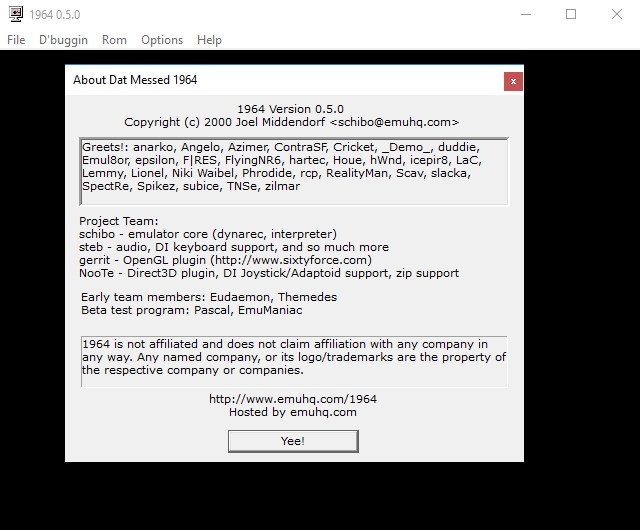
The later official source repository preserves the project’s identity and authorship. It does not make every feature in its final release a 1999 feature. The archived 1964 screenshots used here may likewise depict later versions, and their captions say so. The 1999 story is the beginning of a development line, not its finished form.
The scene around schibo
Middendorf did not work alone. The research record associates early 1964 development with collaborators including steb, NooTe, and Gerrit Goossen. Their contributions show why it is misleading to turn the emulator into one heroic programmer’s private conquest. A broad N64 emulator needed specialists and the willingness to combine their work. It also depended on hardware knowledge circulating through the community, sometimes from people writing rival projects.
1964 would become more capable in later years, but its importance in this chapter is as a durable alternative to the one-release UltraHLE phenomenon. Its public code and iterative releases offered another answer to the question of how to pursue a new and difficult console under the attention that 1999 brought.
Joel Middendorf (schibo) in the History of Video Game Emulation
1999 Part I: When Emulators Met the Lawyers
Joel Middendorf, known as schibo, began the open-source Nintendo 64 emulator 1964 in 1999, choosing steady public development after UltraHLE’s sudden shock.