 Retro Replay Retro Gaming History, Reviews & Emulation
On February 5, 1997, MAME arrived with five arcade games and a DOS command line. A player could type a game name and get Pac-Man answering to a home keyboard. The controls, sound, and picture still needed work, but the arcade was suddenly a little closer to home.
The year the experiments became a scene
Keeping up meant checking emulation news pages, downloading ZIP files, and hoping the instructions inside were current. One program gained sound. Another ran a game that had seemed out of reach. A third disappeared from its host. There was no store to install from or compatibility database backed by years of testing. Each rough build gave players something new to try, and sometimes something new to troubleshoot. By spring, a PC could become an arcade machine or an unexpectedly convincing NES. The software was improving faster than the people and websites around it could comfortably follow.
Getting one machine to work did not solve the next. Arcade boards, the NES, the Super Nintendo, and the PlayStation demanded different knowledge and compromises, and their emulators often needed different kinds of computers to run well. MAME, System 16 Emulator, NESticle, Genecyst, Callus, ZSNES, Snes9x, and PSEmu each tackled a different part of that problem. Some delivered convincing games. Others made exaggerated claims or managed little beyond a title screen. Players had to work out which downloads would actually let them play.
Programmers shared technical discoveries, sometimes reluctantly, while sites such as Archaic Ruins and Zophar’s Domain helped players find the work. The same channels that distributed updates and praise also carried rumors, insults, and files their authors had not agreed to release. A site could help a project reach an audience, then become the place where an argument over it spread. As the programs improved, the relationships around them grew more strained.
Arcade and NES projects surged ahead while a spring argument divided a prominent group of site owners. Work on other machines continued alongside them: the 16-bit race, a new PlayStation challenge, the earliest Nintendo 64 efforts, and another bitter argument in October are followed in Part II. None of these efforts waited for the others to finish.
February 5: five arcade games and a larger idea

Before that five-game release, Nicola Salmoria had written small DOS programs for individual arcade games. MultiPac brought related Pac-Man hardware together; other experiments targeted Pengo and Lady Bug. He combined that approach into the Multiple Arcade Machine Emulator, or MAME. The project’s own history dates version 0.1 to February 5, 1997, with support for Pac-Man, a Ms. Pac-Man bootleg, Crush Roller, Pengo, and Lady Bug. It was a small opening lineup, built around a structure that could make adding the next game easier.
Nicola Salmoria brought separate arcade experiments together as MAME in February 1997. His reusable approach gave contributors a way to add new machines and games far beyond the original five.
Each arcade board combined processors, sound circuits, video hardware, input devices, and its own tricks. Salmoria’s design let developers reuse the pieces they already understood. A new driver could describe another game’s hardware and borrow those shared components, rather than starting over. Even then, getting a game to boot was only part of the job. Someone had to map its memory, identify input lines, and understand how its graphics were arranged. A familiar maze on screen was encouraging; Pac-Man moving at the wrong speed or making the wrong sound meant there was still work to do.

MAME 0.1 already drew on several people’s work. The project’s surviving release record names Allard van der Bas, Carlos Hasan, Gary Walton, Marcel de Kogel, Paul Swan, Robert Schmidt, Sergio Muñoz, and Shawn Hargreaves alongside Salmoria. Contributors supplied code, information, or help with particular hardware. Salmoria provided the design and leadership; others brought knowledge of machines he did not know. As more games joined MAME, more names joined its credits.
For the first players, DOS meant a directory of files and a game name typed with the right options. There was no polished catalog of marquees to scroll through. Getting a game from the pizza place or shopping mall to respond at home could still feel magical, even with a keyboard in place of arcade controls. Players had to map those controls, sound samples could be missing, and the PC screen could only approximate the arcade monitor’s behavior. The game logic was within reach, though parts of the cabinet experience were still missing.
A release rhythm almost too fast to follow

On March 13, MAME took on a machine unlike any it had supported before. Version 0.10 added Centipede, its first game without a Z80 CPU, according to MAME’s official chronology. Ten days later, version 0.12 added Burger Time, whose hardware used multiple CPUs. Getting those games running meant more than lengthening a menu. MAME had to work with a different processor, then coordinate several at once. A framework that could have stayed comfortably among Pac-Man-like boards was stretching, and each new machine exposed assumptions the programmers had to fix.
For players, an update could bring back a game that had vanished from local arcades—or introduce one they had never seen. A news page announced the addition, a mirror offered the ZIP file, and a user might report that the sound on their PC was wrong. Everyone could see the progress and the loose ends together. The maintainers did not claim that every “supported” game was faithfully reproduced. A name on the list meant work had reached the public, not that every detail was right.

The releases could outrun the sites covering them. A February build might be superseded before a fan page finished describing it. Some players kept an older version because the new one broke a favorite game or needed more memory; others always wanted the latest code. Limited bandwidth and fragile homepages left different versions circulating under different filenames. The MAME project’s own chronology helps put those ZIP files back in order.
That chronology also corrects a commonly repeated retrospective that places MAME32’s beginning in February. MAME’s official release history dates the first MAME32 release to July 18, 1997, alongside version 0.26.1. The Windows interface was not there on day one; early users were working with DOS.

The arcade did not belong to one emulator

Meanwhile, other programmers were tackling arcade hardware that MAME did not yet handle well. Thierry Lescot, known online as ShinobiZ, had begun working on Sega’s System 16 family in 1996. His System 16 Emulator reached DOS users in February 1997, aiming at machines behind some of the sound and spectacle of Sega’s late-eighties arcades. Anyone hoping to play Altered Beast or Golden Axe on a PC had a reason to follow it closely. MAME’s long life can make its eventual prominence look inevitable. In early 1997, the field was still open.

Thierry Lescot (ShinobiZ) built System 16 Emulator for Sega arcade hardware. His focused project gave players a tantalizing look at games such as Altered Beast and Golden Axe on a home PC.
Getting a recognizable picture on screen was only part of Lescot’s problem. Sprites could scale incorrectly; a game could boot and still refuse to become playable. Sega’s boards combined processors, graphics systems, and game-specific protection, all of which the emulator had to deal with. Lescot’s source and notes attracted Li Jih Hwa, known as Nao. He contributed a patch that improved zoom behavior in Altered Beast and helped make Golden Axe playable. The later project history places their collaboration in April. With Lescot’s other commitments limiting his time, Nao’s help became especially valuable, and the project grew into a partnership.
Li Jih Hwa (Nao) joined the System 16 effort as Nao. His work on zoom effects and game behavior helped turn promising displays into something players could actually use.

The surviving System 16 project page preserves the authors’ names and the emulator’s identity, though its later screenshots do not show exactly how the February build behaved. Players in 1997 were following software that kept changing, with impressive games and stubborn glitches sharing the same release. MAME was building a broad framework; System 16 Emulator concentrated on a particular family of machines. That focus let its authors spend each release working through a familiar set of hardware problems.
It also gave Sega fans a promise they could picture. The System 16 games might bring a particular cabinet to mind, while a general arcade emulator sounded almost impossibly ambitious. The broader framework could gather knowledge over time, and a specialist could pursue the game someone wanted to play right now. There was room for both, along with plenty of smaller experiments whose names would not last as long.

A player looking for Rygar did not have to wait for a general-purpose emulator to catch up. Around the first quarter of 1997, the surviving Archaic Ruins arcade directory and news log listed programs aimed at individual games, including Rygar, Xevious, and Vanguard, alongside broader efforts such as Xcade and Sparcade. A specialist might run one cabinet better than an emulator that supported dozens. For someone hunting a lost favorite, that was plenty. Their authors also tested ideas about graphics and processors that larger projects could eventually use. The directory dates vary, and some pages were updated later; these entries show the range of projects around that time, rather than a batch of simultaneous debuts.
An NES emulator with an unforgettable name

In the first days of April, NESticle arrived for DOS with a rude name and a much more useful program behind it. Its author, Icer Addis, used the handle Sardu and released software under Bloodlust Software. Zophar’s anniversary account remembers the release on April 3; a surviving Archaic Ruins directory gives April 2. The records disagree by a day. What players found was an emulator that ran a broad range of NES games on modest PCs and made things possible that earlier programs had made difficult or impossible. For many, this was their first encounter with emulation that felt ready to play.

Icer Addis (Sardu) released NESticle and then tackled Genesis and Capcom arcade hardware. The Bloodlust programmer made emulation feel fast, playable, and impossible to ignore.
Pasofami, iNES, LandyNES, and other projects had already brought NES games to different computers. NESticle’s appeal came from how easily and quickly people could get into a game, then start experimenting with it. Its deliberately ugly visual style gave it a personality of its own. Here was useful software that seemed to have no interest in looking respectable.

Addis could build on hardware knowledge other programmers had already shared. Marat Fayzullin had published technical information about the NES and popularized the cartridge-image format used by iNES. Jeremy Chadwick, known as Y0SHi, had helped document details that programmers needed to make the machine work. Addis wrote NESticle, but he did not have to rediscover every part of the console before starting. Public documentation let authors begin with earlier discoveries and, in turn, share what they learned while getting their own emulators running.
NESticle also arrived amid a rush of other releases. Zophar’s later first-anniversary account recalls NESticle 0.20 appearing alongside MAME 0.14 and Rishgar 0.91. That is the site’s retrospective memory of the day, and it fits the rapid pace visible in the software histories. Arcade and NES emulators were improving in parallel. A reader could open one news page and find several new reasons to spend the evening at the PC.
The joy of a game that finally behaves

“Playable” could mean something very basic in 1997. The title screen ended, and your button press moved a character in the direction you expected. The music kept playing after the first room. The score survived a sprite crossing the edge of the screen. Those sound like low bars until you remember that the emulator had to reproduce another machine’s timing, memory, graphics, audio, and inputs. A game image that merely displayed its logo had been news in 1995. By 1997, many readers wanted the full evening back.
NESticle’s speed put that evening within reach of people who did not own the latest PC. Performance still depended on the processor and configuration, but needing less hardware opened the door to more players. Popularity brought a less enjoyable workload for the author: bug reports, requests for support for more cartridge mappers—the circuits that selected which cartridge data the NES could access—complaints about unsupported games, and demands for a Windows version. Players saw a free ZIP file. Maintaining it meant facing a growing queue of expectations.

As NESticle developed, its tools gave players more ways to get inside a game. A save state could return someone to a hard section without making them replay an hour. A graphics viewer exposed sprites and tiles as data to inspect or alter. Users could change settings and take PCX screenshots, turning a discovery into a picture for a website. These tools were useful for casual play, but they also invited hacking, documentation, and translation. Someone who started out trying to finish a favorite game could find themselves studying how it worked.
NESticle kept changing after its first April build. Updates made it easier to use, more compatible, or more versatile, and users grew impatient for the next release. Some functions described in later versions and recollections were not there at the start. NESticle 95, the Windows branch, arrived around August 1997; the project’s end came in 1998.
The sites that made the release matter
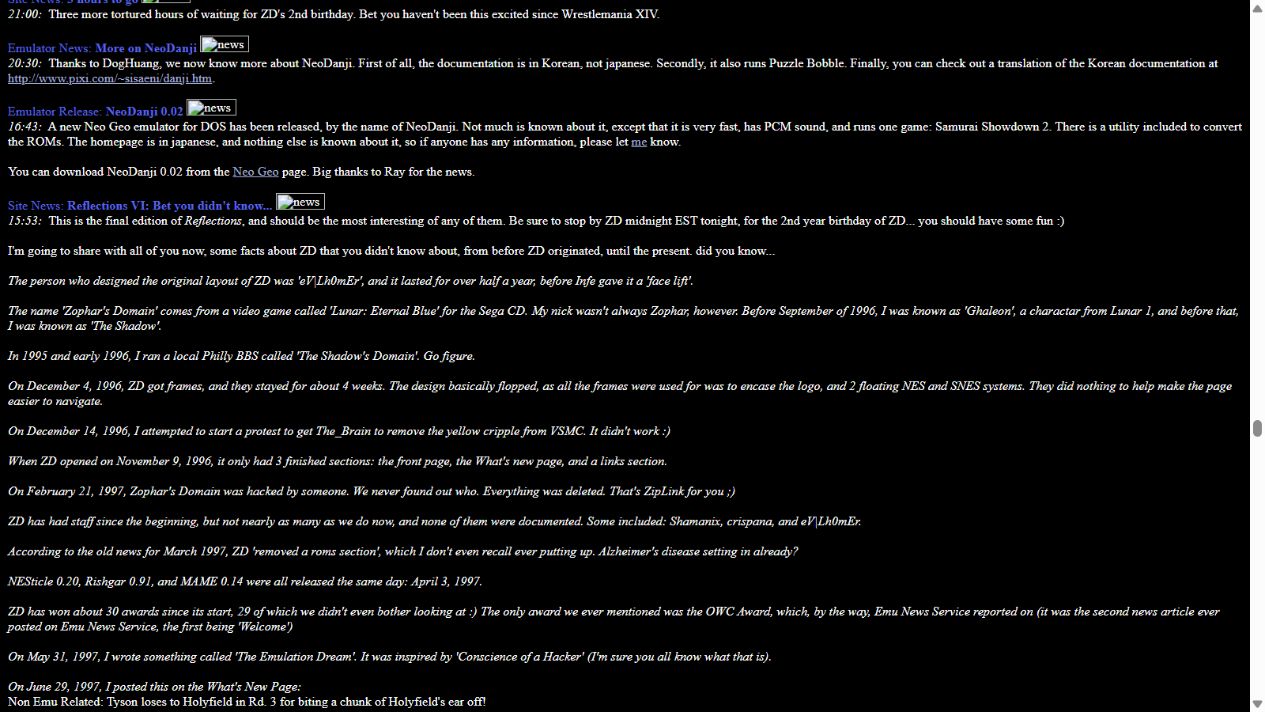
News sites helped those users find each new build. Brad Levicoff’s Zophar’s Domain had begun in late 1996, and Chris Hickman’s Archaic Ruins was already expanding its directories. Their editors linked to releases, described features, mirrored files, corrected old descriptions, and answered visitors. The sites had personalities, too. A reader might prefer one editor’s tone, trust another site’s downloads, and visit both because neither could catch everything.
Stephen Richards (The Fox) helped carry the news as well. His Emulators Unlimited, better known as EmuUnlim, had begun in 1996. By 1997 it was part of a widening network of editors and hosts giving emulator news and projects somewhere to reach an audience.
Stephen Richards (The Fox) Stephen Richards, known as The Fox, ran Emulators Unlimited (EmuUnlim). The site began in 1996 and became part of the widening emulation network in 1997.
Dave (Conjuror) ran another busy destination, Dave’s Video Game Classics. In 1997, Archaic Ruins recommended its arcade coverage when its own directory fell behind. Dave’s message boards gave readers somewhere to compare notes, ask about controls, and argue over what could be shared. One visitor later traced the idea for Build Your Own Arcade Controls to a discussion on those boards that year. When Callus arrived, Dave posted the news himself; a November news log recorded his Callus board and its moderation headaches. The Vintage Gaming Network name came later. For now, readers knew the site as Dave’s Video Game Classics.
Dave (Conjuror) ran Dave’s Video Game Classics, a lively emulation hub whose news and message boards connected readers to new releases. The Vintage Gaming Network name came later.
An emulator could now reach far beyond its author’s personal contacts. So could an argument. A disagreement in an IRC chat channel might appear on a news page, get copied elsewhere, and draw readers who knew neither participant. Editors had to decide whether to host a file, report a rumor, or withdraw a link. Arguments over source-code access, software registration, and distributing someone else’s work landed on the desks of volunteers, whose decisions could shape an emulator’s reputation.
The rush to post news sometimes outran the checking, and the sites themselves could be fragile. Levicoff later recalled that Zophar’s Domain was hacked in February, though his account gives neither a full technical report nor a named perpetrator. Hosts changed, addresses moved, and mirrors kept files available when a main site could not. Being an information hub did not come with dependable infrastructure.
April: Y0SHi walks away
On April 5, Jeremy Chadwick published an explanation of why he was leaving Damaged Cybernetics, an umbrella for several emulation pages and personalities. Readers knew him as Y0SHi, a familiar handle from NES technical documentation and the wider site network. His departure brought a dispute over the handling of another programmer’s work into public view.
In his first-person statement, “Y0SHi Leaves”, Chadwick objected to conduct he said had crossed a line. His statement and Hickman’s later “Damaged Cybernetics” article describe allegations of unauthorized access to another programmer’s files and the circulation of NESticle’s source code. Both were written by participants in the split, who selected the preserved chat excerpts. They show how those participants described the dispute, rather than independently establishing every disputed action.
The accusations centered on Donald “MindRape” Moore, a prominent Damaged Cybernetics figure. Zophar’s 1998 republication of its April 7, 1997 news reported that Moore had obtained NESticle’s private source and offered it in the #emu IRC channel, and that Addis had stopped development in response. The same log reported Damaged Cybernetics’ breakup on April 8, a day after the report of the code’s circulation.
Jeremy “Y0SHi” Chadwick’s firsthand account preserved by Archaic Ruins gave a more detailed account of the alleged access. He said Moore had used a Samba vulnerability to reach a machine holding the source, offered Chadwick a copy before distributing it, and tried the same method against Chadwick’s own system. Chadwick said he refused the copy. These specific claims helped explain the collapse of trust within the group. NESticle later continued development, so the news that Addis had stopped work did not mark the emulator’s permanent end.
Someone could run an emulator’s executable without ever seeing the code that made it work. The source gave another programmer much more: a way to study, modify, or copy the author’s work. Some developers shared it openly; others kept it private. Exchanging hardware documentation was different from distributing a private source tree without its author’s agreement. That prospect could leave programmers reluctant to share even a draft.
The argument beneath the argument
But the source-code dispute was not the only trouble inside Damaged Cybernetics. In his account, Hickman describes a network whose focus had drifted: some sections contributed little, and its ambitions had pulled away from its daily work. He and Chadwick discussed leaving, finding a new home for Archaic Ruins, and separating their projects from the network. The NESticle controversy sharpened those decisions after months of frustration.
Shared reach and shared purpose could get a network started. Keeping it together was harder when pages grew at different speeds, members disagreed about what belonged on them, and hosting costs and traffic were unevenly shared. Handles and late-night IRC did not make those problems any easier. Yet the preserved log contains ordinary kindness alongside the anger. Chadwick offered Hickman space for Archaic Ruins on parodius.com. Leaving a network was much more practical when the site’s files—and its readers—had somewhere to go.
The account also records an argument over cracks that removed registration messages from other emulators. People who wanted information to circulate freely also wanted programmers to have a say in how their work was distributed. Those wishes did not always sit comfortably together. No single conversation settled the question, and it would recur as emulators became more valuable, more popular, and more legally visible. The community was still working out its rules while writing the software.
Zophar’s anniversary piece dates Damaged Cybernetics’ breakup to April 8. Pages and relationships shifted on either side of that announcement; an early-web network did not necessarily close with a tidy final notice. Archaic Ruins continued, and Chadwick continued documenting hardware. The network’s identity had broken apart, but work once gathered under its name carried on in new arrangements.
Another loss in the same week
That same week brought a loss beyond the arguments and departures. Zophar’s later remembrance records that Haruki Ikeda, associated with the Kyoto Genesis emulator, died in a car crash on April 6. The brief notice says little about his life. Readers could know a handle or keep a program in an archive without knowing the person behind it, or why the updates had stopped.
July: MAME gets a window

By July, MAME’s growing selection made browsing more appealing than typing a game name at a prompt. Christopher Kirmse’s MAME32 gave it a Windows interface. The official MAME history dates the first release to July 18, 1997. Players could browse the expanding list and launch a game more easily. The interface itself did not improve emulation accuracy, but it helped people reach the games the emulator could already run. Even brilliant emulation was little use to a player stuck trying to configure it.
A window full of titles also encouraged a different kind of curiosity. A player could click an unfamiliar name, compare games that worked with ones still incomplete, and explore beyond the title they had come to play. MAME began to feel like a library rather than a program summoned for one known game. That shift is hard to measure, but Kirmse had made browsing possible without first asking players to memorize command-line syntax.
DOS MAME still had its users. Some preferred the command line, and Windows 95 PCs varied widely in speed and graphics support. MAME32 also brought another job: every change to the emulation core could leave the interface needing work to catch up. Making a game easy to find and launch was less glamorous than solving a CPU instruction, but it could determine whether someone at home ever got to play. The scene needed people who could do both kinds of work.
October: Capcom enters the picture

In October, Addis gave arcade fans another reason to look at their PCs: Callus, a DOS emulator for Capcom’s CPS-1 hardware. The retrospective archive dates its first public release to October 1997. CPS-1 powered games with larger sprites, elaborate backgrounds, and action that could gather a crowd around a cabinet—a different proposition from MAME’s first five games. Titles such as Street Fighter II, Final Fight, and Strider were now being discussed as emulation targets. For many players, these games were still recent memories.
Callus could tackle CPS-1 on a home PC, though support for the board did not mean every game behaved perfectly. Features continued to arrive later; its Windows branch and network play belong to 1998. Even within those limits, Addis had moved a long way from his famous NES download. NESticle and Callus demanded knowledge of different hardware and reached different audiences. Documentation, experiments, and public interest had helped one programmer move quickly between machines.

Callus gave players another choice as MAME expanded toward more arcade boards. A specialist emulator could pursue one machine with its own priorities, and users had priorities too: speed, sound, a particular game, or an interface they liked. The programs competed for attention, influenced one another, and sometimes shared knowledge. MAME’s later CPS-1 support was still in the future. At the end of 1997, Callus occupied that space in its own right.

The picture could get ahead of the program
The surviving images span different stages of these projects. A correctly dated MAME 0.29 capture can show 1997’s DOS text interface; a much later System 16 Emulator interface shows how that project eventually looked, not how its February build behaved. Other title screens may come from newer builds, and game images may come from original hardware. A modern browser capture of a preserved 1997 article shows the surviving text, which may include later updates, rather than the exact page a visitor saw over dial-up.
December: a different meaning of “old game”

By December, “old game” covered quite a range. Pac-Man was more than fifteen years old; a CPS-1 game could still feel contemporary. The NES had largely left store shelves in some places, but its games remained vivid in players’ memories. MAME and NESticle brought those games onto a computer the player already owned. An arcade fan might recover a favorite whose cabinet had vanished from town. An NES fan could have a childhood library that was portable, searchable, and editable. For programmers, either machine offered puzzles worth solving, even if they never sat down to finish a game.
Getting the emulator was only part of getting a game running. The commercial game data was separate software, and fan sites often put discussion, downloads, and ROM links close together. That mixture drew complaints from rights holders and arguments within the community. People came to emulation for different reasons; a download was not automatically an act of preservation, and an emulator was not necessarily written to encourage infringement. As more players found the programs, more people began examining what came with them.
Players were exploring new 3D worlds while programmers worked out how to bring older favorites back to life. Diddy Kong Racing in Retro Replay’s GameBase puts a current-console release alongside those rediscovered games. Its cover tells us nothing about how well a 1997 Nintendo 64 emulator could play it, but it captures the distance between what players could buy and what emulator authors were trying to reproduce. Part II follows the programmers who began to close that gap—and the argument that erupted when two SNES teams seemed to get there at once.
People in this chapter
- Nicola Salmoria — MAME’s founder, who turned a group of individual arcade experiments into an extensible project.
- Thierry Lescot (ShinobiZ) — creator of System 16 Emulator, which targeted Sega arcade boards with specialist attention.
- Li Jih Hwa (Nao) — collaborator whose work helped System 16 Emulator move beyond promising displays toward playable games.
- Icer Addis (Sardu) — Bloodlust Software programmer behind NESticle and Callus.
- Dave (Conjuror) — site owner whose Dave’s Video Game Classics carried emulator news and hosted the community around it.
Sources and further reading
- MAME project history and MAME 0.1 release record for dates, original games, and contributors.
- System 16 Emulator project page for the project and author credits.
- Zophar’s Domain anniversary account for its recollection of April 1997 news and site events.
- Y0SHi Leaves and Damaged Cybernetics for contemporary, participant-authored accounts of the April split. Allegations remain attributed.
- Archaic Ruins NES directory and arcade directory for surviving period listings; pages may include later updates.
- Archaic Ruins April 1997 news log for contemporary listings and the site’s response to Y0SHi’s departure.
- Dave’s October 1997 Callus post and StormWorld’s November 1997 archive for the site’s contemporary role.
Part of: The Complete History of Video Game Emulation
People introduced in this chapter: Nicola Salmoria, Thierry Lescot (ShinobiZ), Li Jih Hwa (Nao), Icer Addis (Sardu), Dave (Conjuror), Stephen Richards (The Fox)
Browse biographies: People in the History of Video Game Emulation