 Retro Replay Retro Gaming History, Reviews & Emulation
Retro Replay Review
Gameplay
The first few fights can be genuinely disorienting if you arrive expecting standard Toshinden or a conventional 2D fighter. Every character uses the same basic six attack categories—hard, medium, light, low, special, and desperation—but blocking has been replaced by a parry for non-low attacks. Lows cannot be blocked at all, so you have to sidestep them. It is a rule set that forces you to pay attention to what is coming rather than sitting safely in defense.
Once that starts to click, the game has a scrappy little mind-game at its center. You are weighing a parry against an incoming high or mid-style strike, a sidestep against a low, and the option to dive under non-low attacks. The 3D arenas give those evasive moves room to matter. This is not a combo-heavy fighter where you memorize long routes and cash out; it is more about anticipating an attack and picking the specific answer the game demands.
That sharpness is also where frustration can set in. A missed read is costly because the defensive system is so particular, and the compact attack setup means the character differences live in range, speed, and behavior rather than dramatically different toolkits. Eiji firing a carrot from his sword instead of his usual fireball tells you the tone: playful, familiar, and deliberately odd. Sofia’s altered Aurora Revolution likewise gives returning Toshinden fans a recognizable point of contact, but the game asks them to relearn how defense works.
The roster is modest but focused. Eiji, Sofia, Ellis, Tracy, and a hidden character arrive from the first two PlayStation Toshinden games, while Ryuji, Rika, Baifu, and Shu lean into school-character stereotypes. That is enough variety for learning matchups, though not enough to make the game feel bottomless. The unusual practice mode is memorable too: rather than a plain training screen, it uses short instructional videos hosted by an enthusiastic Japanese woman alongside a small CGI Rika. It is a charmingly strange way to teach a game whose rules need explaining.
Graphics
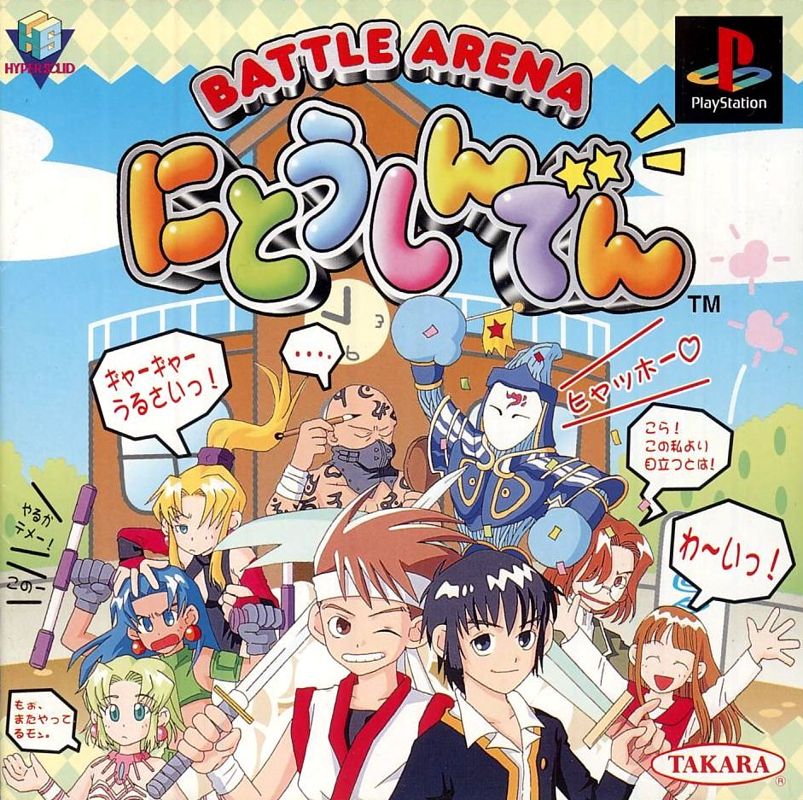
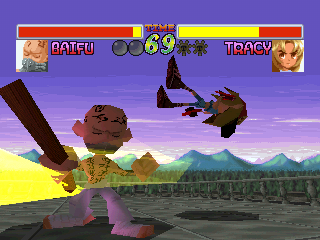
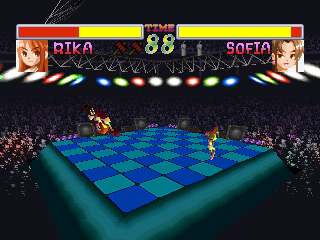
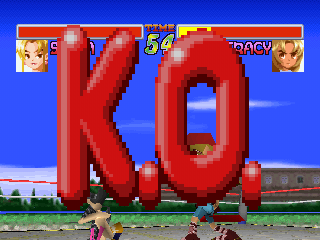
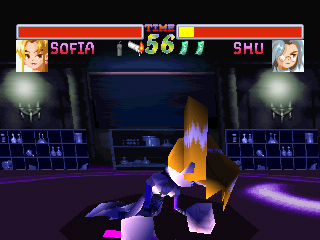
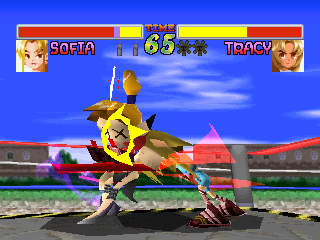
The fighters are rendered in an exaggerated anime style, with huge heads, tiny bodies, and cel-shaded textures that push this well beyond the look of the main Toshinden games. The school setting and caricatured cast suit the sillier tone, while the 3D arenas make sidestepping easier to understand than it would be on a flat plane.
Story
There is not much dramatic weight to chase here. The high-school framing mainly exists to recast Toshinden faces and introduce a handful of new fighters as broad school-anime types. That is a sensible fit for a spin-off that is more interested in turning Eiji’s sword projectile into a carrot than expanding a serious conflict.
For returning fans, the fun comes from recognition. Eiji, Sofia, Ellis, and Tracy carry series familiarity into a deliberately more comedic setting, and the altered versions of their signature ideas make the game feel connected without pretending to be a straight sequel.
If you want a fighter with a substantial narrative hook, this is unlikely to satisfy. Treat the school premise as a playful wrapper for the matches and its tone lands better: it is a compact parody-adjacent detour, not a lore-heavy chapter.
Overall Experience
Battle Arena NiToshinden is at its best when you stop trying to play it like every other fighter from its era. The lack of normal blocking gives each exchange a tense, slightly awkward rhythm at first, then a satisfying one once parries, dives, and sidesteps become deliberate choices. It has a real mechanical angle rather than merely borrowing Toshinden names.
Still, this is a niche spin-off. The four returning fighters, four school-themed newcomers, and hidden combatant make for a concise cast, and the shared six-attack structure leaves less room for wildly different fighting styles than the character art initially promises. Its longevity depends on whether its defensive guessing game grabs you.
For a Toshinden fan, the oddball humor, returning faces, and altered rules make it worth a look. For anyone else, it is a curious old fighter with a demanding defensive system and a lot more personality than polish. The payoff is there if you enjoy learning its peculiar answers to every kind of attack; if you mainly want combos and conventional guarding, it will feel more stubborn than clever.


Reviews
There are no reviews yet.